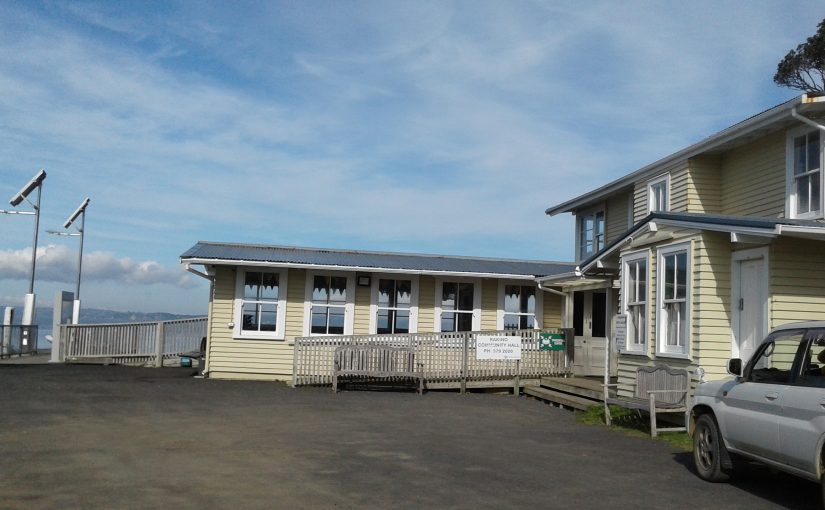
Waiheke Local Board visit to Rakino, and Hall update.

Preamble by Lisa West

The following account by Kevin Wragge is a report on the perplexing behaviour of a small group of people who purport to represent the Rakino community, most especially with regard to Local Board, and council officials. It refers to a meeting we were all excluded from, despite it being a very rare opportunity to engage with our democratically elected representatives from the Waiheke Local Board. It is also important to note that permanent residents were excluded, bar one.

I was alerted to this meeting ahead of time by the Chair of the Local Board who wanted to ensure I had been invited as I had expressed strong interest in attending previously. Both of us believed it was a meet-up available for community members to attend, so after becoming concerned the community weren’t aware of the impending visit, I let you all know of the meet-up.

I was then publicly uninvited by an RRA spokesperson and accused of spreading ‘misinformation’. To his credit, Mr. Kevin Wragge attended and was not intimidated into leaving, despite attempts by RRA committee members to do exactly that. Mr, Wragge has made the report following for the rest of us to enjoy.

If there is one thing that makes me righteously angry about this wasted opportunity for us to meet our democratically elected representatives it is the knowledge that the meeting was held in our red-stickered Hall, the Hall we are told has cameras installed, to capture any ingress by miscreants.

In the last few years anyone trying to organise an event for the community has had to impose on the generosity of others in order to find suitable venues; the Freckers for a presentation on kororā, Dylan, and Garth and Kate for the Lez Ball, Holly for the septic tank workshop, Harriet for hosting market days, and Bert and Natalie for hosting gatherings at their house, most especially meet-ups with staff from the Waiheke Resources Trust.

The notion that the RRA committee thought a red-stickered hall was the best place to hold a meet-up with Local Board and council staff is extraordinary when they impose exclusion on the rest of us, to the extent of boarding up the stairs to the safely locked art rooms before giving us the opportunity to get personal possessions out. Who, if anyone, gave authority for that action?

I’d like to finish on a positive note, and in agreement with Kevin. We are all on the same page; we desperately need a neutral community space to gather in on occasion. The community hasn’t been given a complete picture of the complexities to date, and that needs to be remedied urgently. As part of my submission on the Waiheke Local Board plan I’ve asked if the Rakino community can be updated regularly on Hall progress, by the Chair. Anything will be an improvement on what we currently get.

Kevin Wragge’s
account of the meeting is below.

My meeting with the Board on Rakino with regard to the Hall with an end message to the Rakino Rate Payers Association and its committee.

I thought there may be some interest in my interaction with the Rakino Rate Payers Association (RRA) and the Waiheke Board when it visited Rakino on Friday the 17 th July 2026 at 10am.

Kylee Matthews the Board Chair had indicated in writing to a couple of Rakino parties who had expressed interest in attending a meeting with Local Board that a delegation would attend Rakino at the Boards initiative to assist in the decision-making process with regard to the future of the hall. 

Kylee had previously stated that she believed the meeting would be open to the community, so the assumption was made that my attendance would be accepted, if not welcome.

I emailed the RRA and asked for the visit to be publicised in order to ensure rate payers could attend and learn at first hand why little or no progress had been made to have the hall rebuilt after many decades of talk and stagnation. 

The Friends of Rakino Face Book page reveals the interactions that subsequently took place. 

The RRA via its spokesperson Jude MacLachlan (JM) maintained the meeting was closed despite written correspondence to the contrary and insisted that no one from the community should attend. 

As the Board’s visit had been signalled in advance I resolved to attend and travelled to Rakino on the Wednesday prior to ensure I could attend the 10am meeting. As has been said, Friday was not the best of days for participation and timing seemed to overlook that the Belaire ferry arrives at 11.20am on a Friday. 

I went to the wharf in good time and greeted the Chair (CC) and Mr. Inglis (RI.) 

Both were ashen and initially refused to acknowledge my presence. 

In good time RI stated that it was essential that the meeting was positive and that was the objective of the day. 

I agreed full-heartedly and suggested we also needed to establish the RRA’s entitlement to represent me and the community and asked him the number of paid-up Association members. 

RI grimaced and with significant emotion and volume said he did not know. 

I asked why he would not know and suggested that it could be concluded from the minutes of the last AGM wherein it was stated that $600 had been collected by way of subscriptions that the number would be in the vicinity of eight, including committee members. 

RI howled that he did not know and then screeched, did you hear me, I don’t know. 

CC smirked and commented that I had no idea, implying my assumption was wrong. 

I responded that was the very point and RI should be ashamed of supporting this committee given his professional and business background. 

CC then mentioned I had sent him over two hundred emails and one day he would take me to task. 

I stated that I welcomed the day as it was my democratic entitlement to ask questions, demand answers, voice concerns and hold this entity to account. 

CC also brought up a private matter in the public domain which I will not record for these purposes. 

JM arrived and questioned my attendance and again stated to her entourage that this was a closed meeting. Natasha arrived by way of boat. I greeted her. I also acknowledged Stephen Wong when I caught his eye. 

The water taxi arrived and I stepped forward to greet our visitors who unlike our committee are democratically elected. 

I spoke to Chairperson Kylee Matthews to begin with.

I had previously emailed Kylee and mentioned the conflict with regard to the meeting, the Association, compliance with its Constitution and communication with the community. 

Kylee acknowledged the confusion and stated that she would address the issue a little later. 

I met Board member Mr. Eric Hillman and Mr. Mike Lee and mingled with support staff whose names I can’t recall, which is my failing entirely. 

We entered the hall and took up seats as JM continued to question my attendance with those who would listen. 

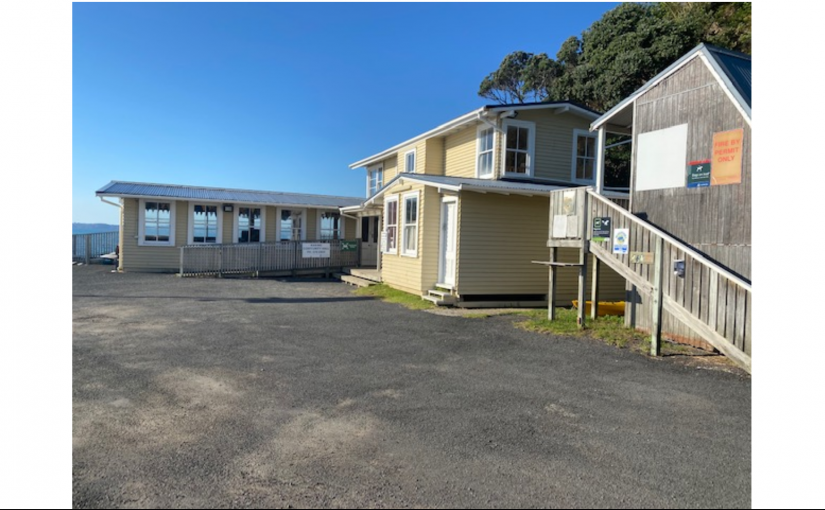
I immediately drew the meetings attention to the fact that the hall had been red stickered yet the meeting was taking place in a structure that was not available to the community. 

That was acknowledged by Kylee, as was signage. 

Introductions took place and JM queried who should chair the meeting given that it had been arranged by Council. 

JM also stated that a tour of the Island had been arranged with vehicles at the ready. 

JM passed the control of the meeting to CC who began speaking but was then assisted by someone suggesting that it might be appropriate for introductions. 

JM took notes and explained that she had returned to the Association to help the Chair as a consequence of his health issue. She also mentioned that she had earlier resigned as a consequence of my emails imploring the Association to do as it should. These are described as bullying. 

Kylee explained the confusion with regard to attendance which revolved around catering. JM asked with whom the correspondence was with and was dismissive of Kylee’s answer.

Nothing of significance occurred other than JM’s ongoing hostility toward me.   

RI seemed to think it important that he refer to his house fire and architect Pip Cheshire who had been commissioned to undertake drawings for the new Hall build. 

Mr. Lee mentioned the tremendous ecological change to the Island which was acknowledged by all and to which I commented that no one on the committee had participated in those plantings or indeed had shown little or no interest in the cause. 

JM strongly objected and stated that she and a Mr. Lockhart had planted 400 trees and that I was once again wrong. I chose not to respond as I was of course referring to the planting of the Wallis Reserve, the West Bay track, securing funding for two ten-acre block owners and instigating the establishment of the nursery. 

When I attempted to correct exaggerated, wrong, or erroneous comments, JM stated that it was not my right to speak. She sat alongside Mr. Hillman and when I did speak directed derogatory remarks to him in an undertone. 

As this was an informal meeting Robert’s Rules of Order and procedural niceties seemed not to apply. I had noticed this bias at prior RRA meetings where speaking rights seemed to be selectively applied. 

JM in particular seemed to be entitled to contribute at any stage and lamented how the community simply did not appreciate how much effort had been expended by the committee to resolve the hall impasse and mentioned that there was always the next hurdle to encounter such as the historic trust review and indigenous claims. 

CC mentioned the Fire Shed and AT’s attitude to approval of the use of AT land where significant costs were sought. 

He spoke with pride of the hundred per cent approval of those attending the presentation by architect Pip Cheshire and doubted that would ever happen at Waiheke. 

When questioned, he stated that the fire shed had cost 50k although I do not believe that expenditure has been disclosed in annual accounts. The secretary should do so now. 

He also mentioned fire equipment had been sold to him for one dollar within here. 

I do not believe Association accounts depict the hall or the fire equipment as assets and that should be remedied immediately. 

CC commented on a number of occasions that he understood my frustrations with the lack of progress and I took that as being sincere. 

At this point Shane Hogg took the floor and some semblance of purpose began. 

I am now in no doubt that Shane is on top of this project and all its complexities which have never been disclosed by the RRA who have explained delays as being attributable to Council finding yet another hurdle to prevent progress. 

I will ask Shane to provide a summary of his presentation to ensure all are aware of the issues he is contending with but would summarize the situation as being multi-faceted which include not only the obvious funding constraints but issues with regard to ongoing reform and restructuring within Council. 

These factors come to mind and are not exhaustive as I did not take notes. Indeed, this summary may not necessarily be accurate but simply draws attention to the complexities. 

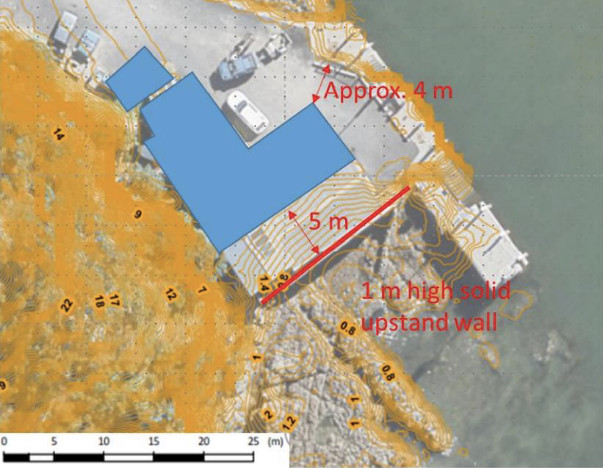
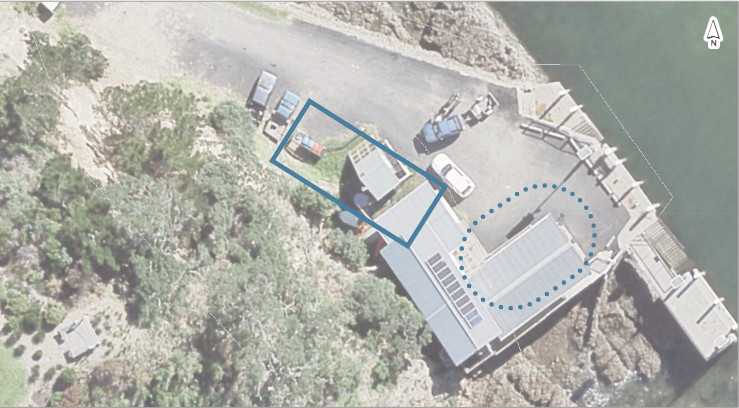
The building straddles complex public boundaries abutting the wharf with AT and Council negotiating distinct and conflicting legal and operational mandates over this foot print. 

The hall consists of multiple parts (the hall, Kitchen/library and toilets) and is built on reclaimed land over two public land parcels. 

Because the proposed facilities interface with transport infrastructure, AT to this time has exerted significant control over the land and its development and until now would not consent to the hall encroaching its land. Furthermore AT have refused to provide a terminus.

The rigid separation between AT and Council which has caused the developmental deadlock is being dismantled by way of the Local Government Amendment Act which seeks to dissolve AT’s independent authority. 

The transition period is under way and once worked through will mean that land ownership and decision-making responsibilities will transfer to Auckland Council and the Waiheke Local Board. 

I asked Shane if that meant everything is on hold until that happens and I think he agreed. 

Shane spoke of inter-departmental participation which includes the Coastal Marine division as the hall sits on reclaimed land and is subject to severe tidal inundation and storm damage, Earthworks and sediment control, Structural Engineering and geo-technical input, Parks and Reserves, Heritage and Mana Whenua, Fire and Emergency, Hazardous materials, Vehicle manoeuvring, Health and Safety along with Civil defence, First Aid etc etc etc. 

To remedy the crumbling bank would cost in excess of two million dollars which explains the set back that has been demanded. 

This is as much as my little brain could take in and as such any negativity with my summary will fall on closed ears. 

I then mentioned alternative sites which Shane was fully acquainted with and had considered in some depth. 

The two alternative sites are road reserves with the right to occupy involved as construction is a non-complying activity. I believe that may change with the implementation of the Local Government Amendment Act. 

JM seemed not to be aware of these complexities but did seek confirmation that the existing build would include a kitchen. 

Mr. Lee was astonished with the inter-departmental mischievousness and questioned the veracity of many of the claims and requirements being sought and undertook to investigate further with material to be provided by Shane. 

When I suggested that AT should provide a terminus and Council a hall on the other possible locations available RI claimed that was unacceptable as the community would lose its identity and soul or words to that effect. 

I sincerely thanked Shane for his contribution and added that I had no recognition of all the issues that had been presented. 

At one point a long-standing member of the community arrived and was offered seating. 

I mentioned he was not a member of the Association to which JM responded he was welcome and was being invited to participate unlike myself. 

I found that unnecessary and frankly nasty. 

I spoke further with Shane and Mr. Lee outside and indeed apologized to Shane for my terse correspondence with him. I explained the disconnect between what the Association was saying and Waiheke Board minutes and was attempting to understand the process. He stated he understood my dilemma. 

Mr. Lee and Board member Hillman invited me to come to the alternative sites and I decided to do exactly that. 

I reluctantly agreed to participate in a few photo shots at the wharf and at the top of the Island. 

Two groups formed around the fire house. One included Shane Hogg, Mr. Lee, Board Member Mr. Norm Robins and myself. 

We discussed the site layout and its suitability as an emergency gathering point as opposed to the wharf which had limited access. I also suggested that although probably unnecessary the road could be re-routed to accommodate any structure. 

The other group was entertained by the Rakino committee with CC starting the generator and sounding the siren. 

Mr. Robins asked me what happens now to which I replied we don’t know and then adopted the Lance Corporal Jack Jones impersonation of “Don’t Panic” “Don’t Panic”.

The gathering wound up and my former detractor RI said with a smile, “You did well”. 

I choked.

Mr. Lee stated that we need to get you on this committee to which I responded, not with this lot. 

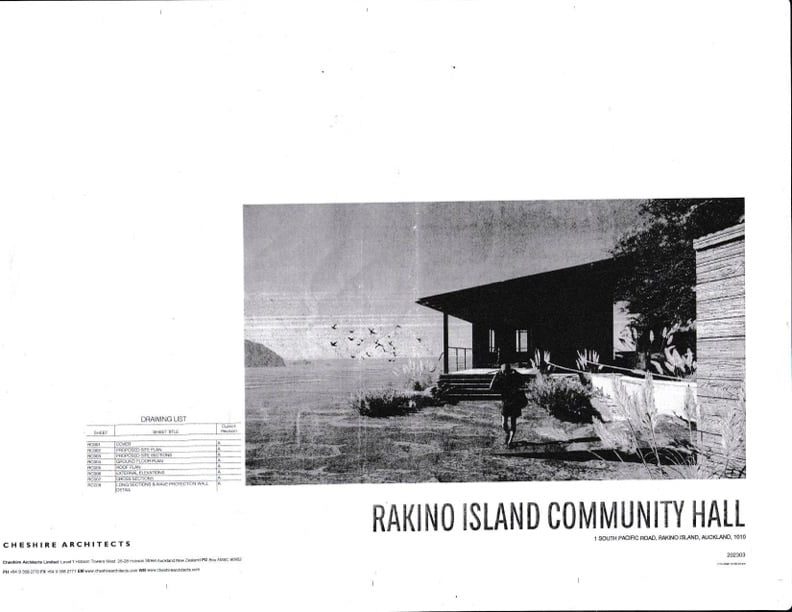
Shane had earlier provided me with a final draft of the build which is attached.
 
I suggest everyone carefully look beyond the pretty presentation at what is being offered for some millions of dollars. Notice a block wall which will not only obstruct views but will also make access to the ferry even more problematic.

Everyone is entitled to their own opinion on the Hall rebuild but a consensus must be reached. 
I hold the view that the current site has too many restrictions and limitations to erect a structure that meets the Island needs and that value for money will not be achieved.

I believe AT or what ever that ends up as should construct a transport terminus and a hall is built elsewhere for a fraction of the money and which would be more fit for purpose. 

At the end of the day, I don’t care what happens as long as something happens. 

Now to the point of all of this. 

The RRA and the committee overlooks one very important fact. 

Everyone is actually on the same page. 

Everyone wants the hall saga resolved. 

It’s not a them and us situation. 

It’s not a psychological division between an “in group” being the Association and its limited members and “the others” as happened to me yet again at this gathering. 

The animosity is shameful and must end. 

I believe this committee should resign on mass and let someone else have a go. 

Pip Cheshire’s design for the proposed Hall.
How Freakin’ Good Was THAT Rakino???

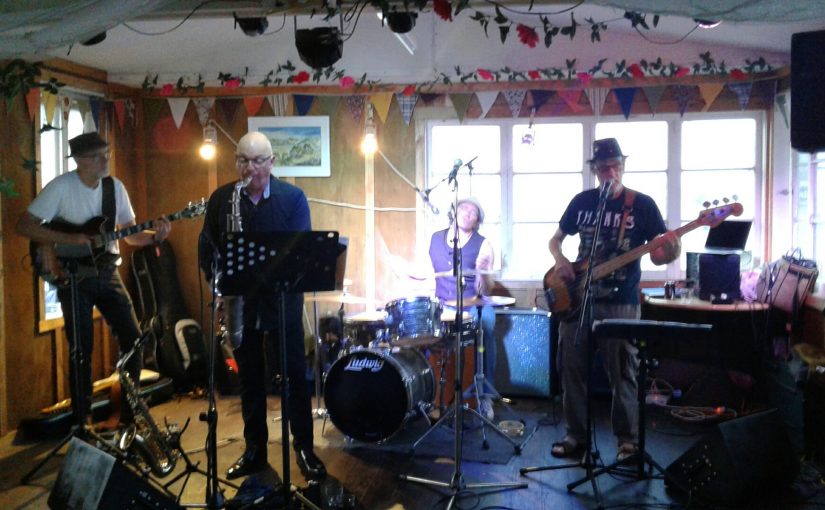
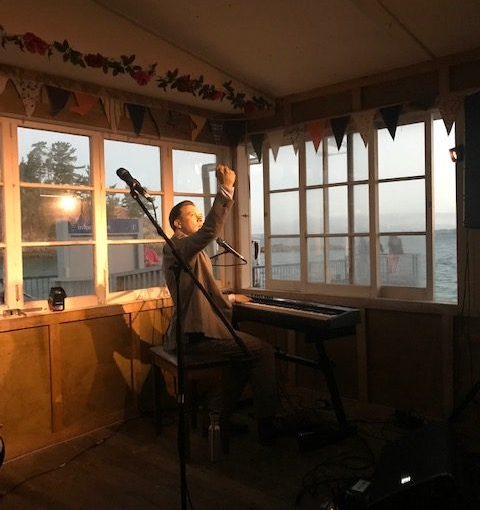
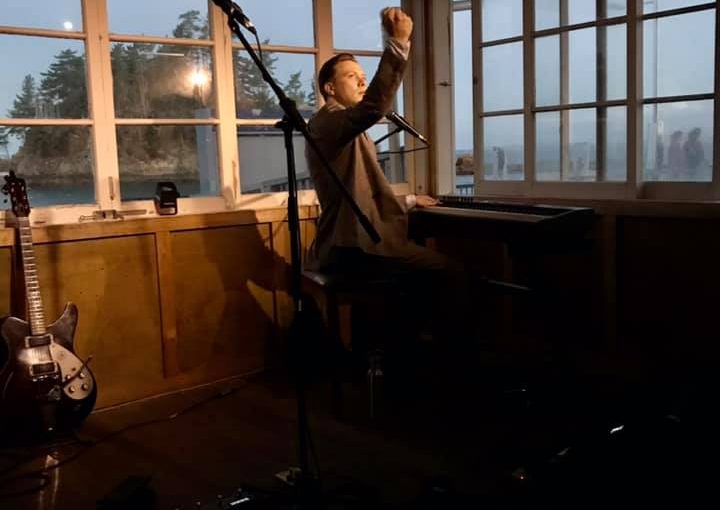
I’m arrogantly confident I’m speaking for all who turned out when I say that JT & Agnostics with Holly Shepheard was another ripper of an island event.

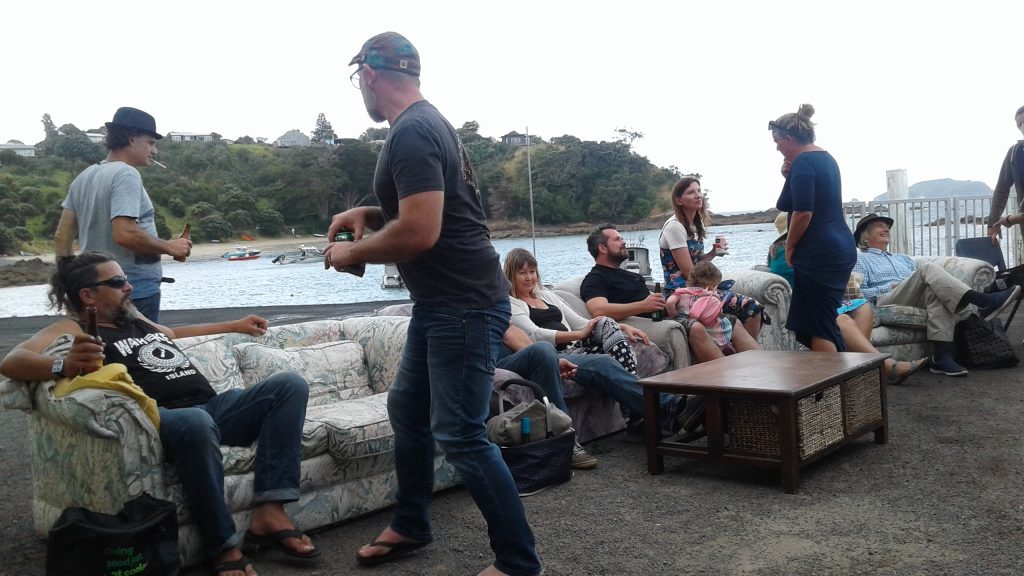
The pre-gig outdoor lounge with likely lads.

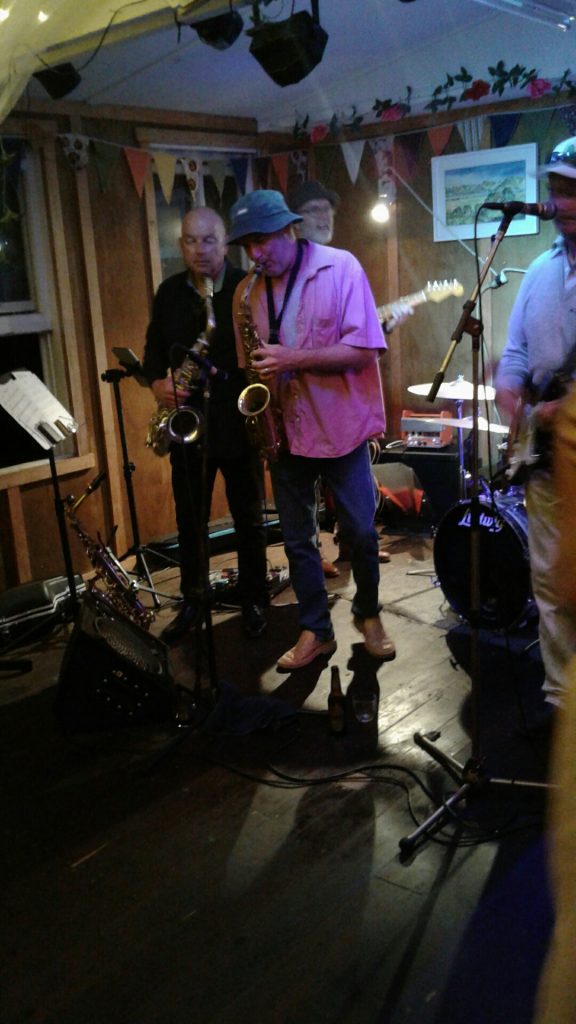
JT is bass player John Thomson, and the Agnostics are a confection of Maciek Hrybowicz on guitar, Bill Forrest on saxophone, and Freddie Limbert on drums, all accomplished musicians from Waikato.

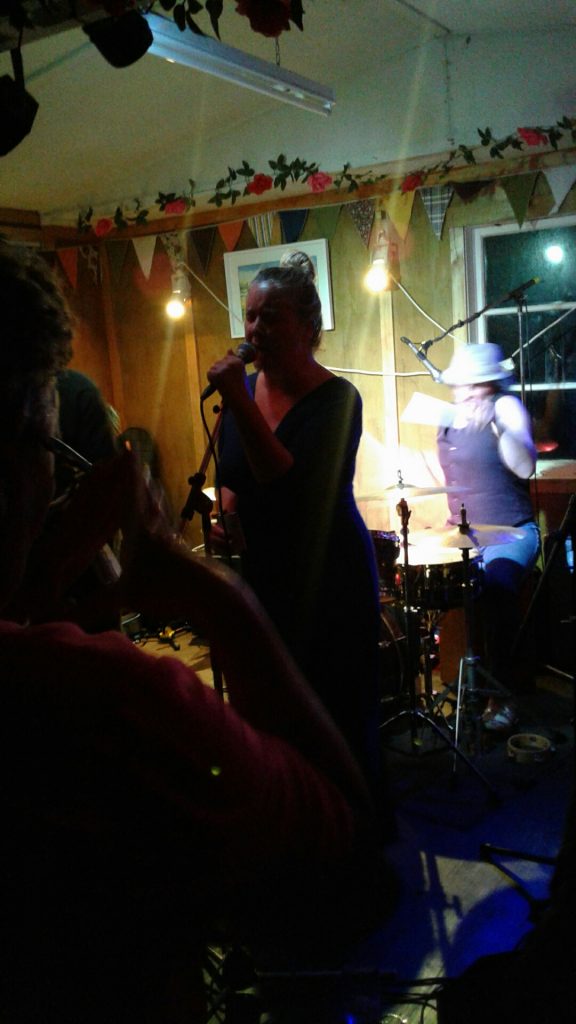
Holly Shepheard guested on vocals, and we were also treated to a set featuring Massey Ormsby as guest vocalist, with the addition of Rakino’s Tom Donaldson on saxophone.

The first set seduced the audience in gently with a set of blues originals by John, followed up by a second set in which Holly exercised her impressive pipes to the approval of the enraptured crowd.

Holly exercising her impressive pipes.
Guilty, as always…

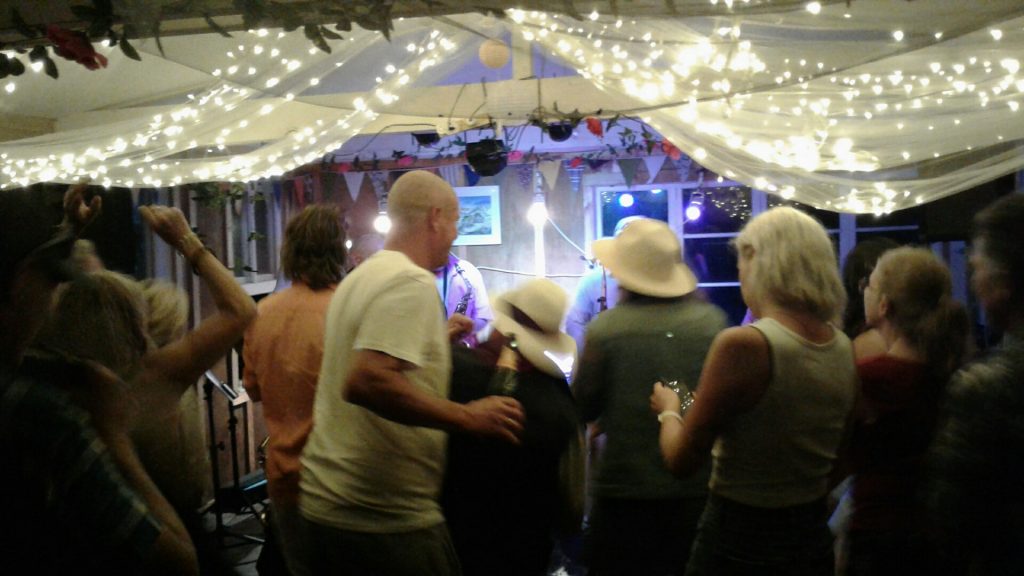
Rakino knows how to turn on a hooley, so it wasn’t long till the carefully placed chairs were thrust back against the walls and the the hedonism started in earnest, led in large part by Mr. Garth M. Broadhead who knows how to cut a mean rug. He spun and dipped his dancing partners with aplomb, and kept the admiring audience in thrall.

Mr Garth M. Broadhead rug-cutting.

The rest of us ponied and chicken-scratched, and Billie the Dog participated in some horizontal dance moves later in the evening. Even the committed outdoor loungers and boozers were enticed inside for a bacchanalian blues boogie.

Bacchanalian Blues Boogie.

My abiding memory of the third set was of the band with Massey at the helm doing a beaut version of ‘Wild West End’, making Dire Straits sound soulful and cool… again. 🙂

Tom on sax! Massey to the right on vocals!

Our much-loved Hall juts precariously and spectacularly above the tide, and as the last set was ending I glanced out the open window and to my discomfort spotted the sea churning in, the inundating waves of the very high tides of recent days. I noticed the sea was at wharf height and the waves had created visible puddles as we hefted the couches back indoors post-gig.
The after parties continued for those with fortitude or limited sense of self preservation, and I had to crawl Hulk-wards at 3.30am because I’m a lightweight.
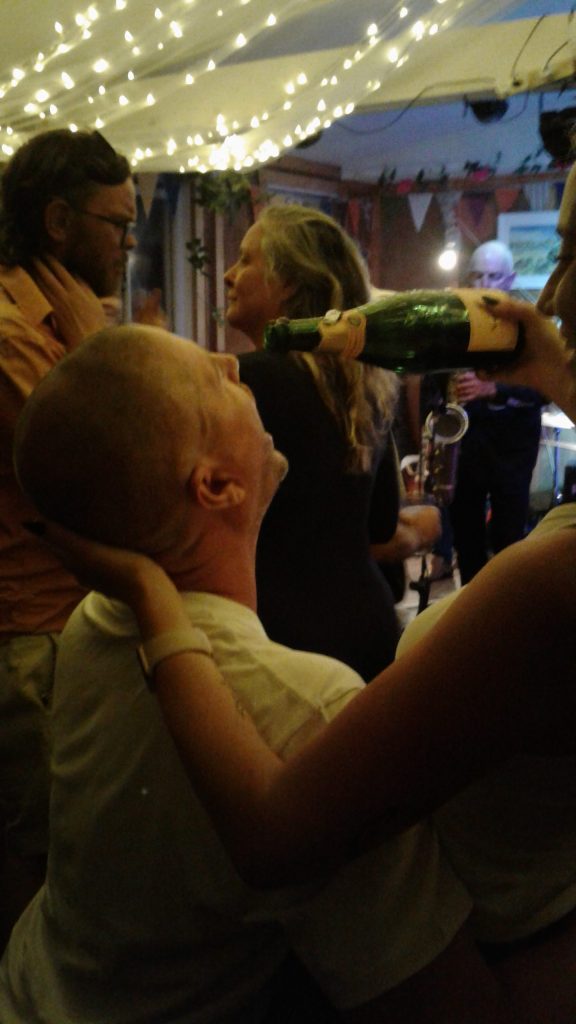
Blues and sybaritism were the winners on the day.

Sybaritism winning.

RRA Election time?

Is it time to review the function and performance of the RRA (Rakino Rate Payers Association)?

The objectives of the Association are set out in its Constitution.

At the Annual General Meeting candidates either volunteer or are persuaded to join the committee sometime later. There is no election process as is defined. Elected officers are those who volunteer for that role. Not much happens. There’s little or no communication with the membership. The Association doesn’t enjoy community support and more importantly respect. All fairly typical characteristics of any volunteer organization. Well-meaning. Volunteers doing their best, but is their best good enough?

In recent times things have been organized independent of the Association. We have enjoyed concerts at the Hall, the Nursery and at the Pizzeria. Yoga classes, art, weaving courses are all well received and supported. The community can make things happen if it has the will. Who needs the Association?

It does seem that decentralization will continue which questions the relevance of the Association and especially as it has seldom taken a lead or achieved much. The hall is but one example. Our emergency response capability is being withdrawn. The Association fiddles whilst Rakino potentially burns.

The Association is nevertheless essential as the body that represents us when dealing with say the Council. Council will only deal with the one voice. The problem with that one voice is that the committee is not democratically elected, doesn’t have a mandate on any position it takes, is seldom well informed and invariably reflects the opinion of the committee or some on it.

We have allowed this situation to occur. We don’t follow the prescribed process for the election of a committee and a Chair. We don’t give them a brief, a blue print for what we want for the Island, where we are going and how we want to get there. If we don’t manage change, it will happen regardless.

I believe the function of the Association should be three-fold;

  1. To achieve representation on the Waiheke Community Board.
  2. To represent the community with key stake holders and deploy expertise within the community for specific negotiations.
  3. To develop a road map which reflects the communities needs and aspirations, coordinate a blue print and invite people to take on specific function, unhindered. Performance is measured by success.

The Hall is a prime example as to why there must be change.

After years of talk, Stephen Thomas came up with a scheme to move and redevelop the existing building which he costed and presented to the community both on and off the Island. His concept was well received and he was congratulated on his initiative. We were to be canvassed for our thoughts. A no brainer really. Unfortunately, covid aside, nothing has happened. More of the same and for the same reasons.

We were told at the last AGM that Council preferred a new build on which premise a vote was taken to do away with the old and bring in the new. A concept by the Association was presented with a few boxes and improved vehicular access. It has since transpired that Council did not express that preference yet a new design is being developed after Stephen Thomas presented his vision and the ink had almost dried. Stephen had broad approval for his concept and has the skill set, drive and contacts to make things happen. Local trades, professionals and merchants offered their support. Meetings brimmed with enthusiasm and suggestions as to how it could happen and how individuals could contribute.

Stephen should be given the job to resolve the hall fiasco once and for all. He has the qualifications to present a concept and costings to the Waiheke Board, get approval from the Board, facilitate funding and consents, negotiate with Auckland Transport as regards transportation issues and bring the community together to build with fund raising if necessary. No one else on the committee has those skills and frankly they have had decades to demonstrate their capabilities. A significant job for a lone individual but Stephen is a team player and can call upon expertise within the community to finally resolve something which has been on the drawing board for decades.

No more delays awaiting the formation of a committee, no more waffle and grandstanding. Responsibility delegated to someone who know what they’re doing. Job done.

What else does the community need? Here’s but a few thoughts to make my point.

Entertainment.

Lisa and Holly have shown to have the drive and passion to organize fantastic events with fantastic artists. They should be given carte blanche responsibility with an allocation of funds from the Association. The community should underwrite the associated costs and be willing to pay to participate rather than stand on the fringes and observe.

Sense of community

Why not our own flag, an Island logo, a letterhead, some merchandise that sets us apart. Let’s appoint someone with those skills, which may also include a programmer so that we can vote electronically on whatever design we prefer. The same program could be utilized at the AGM and at other significant decision times.

Other thoughts are; fruit trees along the berms, utilization of the land at the top of the Island for sporting events, a website which brings together all the other sites under the one umbrella, resolution of the mooring travesty, a welcoming committee for new owners, an information centre for visitors.

The possibilities are endless. Someone with a special interest or skill takes responsibility for a specific function after being provided with a broad outline of what the community wants.
Once again, answerable to us, not the committee which in time becomes largely redundant much as it is now but is no longer permitted to stymie innovative thinking or enthusiasm.

Thoughtful comment would be appreciated. The next AGM is over Labour weekend. Change is necessary now. I believe we need fresh blood on the Association. There are many talented impassioned people out there to make a real difference. I believe that needs to begin at the top.

A resident’s observations on our Hall complex.

My feedback for community hall, library, art room, mail room, emergency response storage, ferry terminal facilities.

I have carefully tried to list all of the uses of the island’s only community structure as it is important to keep all of these in mind while trying to decide how to move forward.

Moving forward is a key consideration, it would be a true shame to see the loss of any amenities  as amenities are a rare commodity on our beautiful Motu. I am fortunate enough to have made this island my home and so am in a position to see how, when and why these buildings are used. I certainly don’t deserve more of a vote than any other landowner but do have better perspective than most and, with all due humility, expect to be listened to.

My strong feeling is that the existing, historic, structure needs to be preserved in some manner. While a new build may have advantages in terms of a reduction in short term maintenance requirements it (to my mind) will not provide the same facilities as does the current structure. I in no way trust that Auckland council will consider an increase in size or utility of the building(s). I am trying to remain logical about the situation but need to briefly say I can’t see how any new building would hope to have the same warmth and heart.

My preferred option would be to remove the hall/kitchen section and move it, raised .5 metres to secure it against surge tides, to the area seaward of the existing toilets. The jutting section of the art facility could then be mounted on poles and a small 1.2 metre concrete wall built on the Southern edge to further protect all structures. This would also provide a safe waiting area for humans and animals. The existing parking beside the bins would be designated pick up and drop off only thus becoming a safe turning area for vehicles.

As a final note I hope all due efforts have been made to consider the non internet savvy in our community. Of course there are limits to any form of communication but all must be consulted on decisions that affect all. Aside from the natural beauty it is the personalities of us all that make the island a special place.

Thank you for your time and consideration.

Josh McCann

My view on the hall

As you’ll know, the position of the hall is something of a problem, as king tides can cause inundation and damage. Recent goings on in the RRA have prompted me to have a think about what should happen to the hall, I poked around council reports, costings, and the possible solutions. It looks like boiling down to:

Two Options
There seem to be only two solutions on the table, demolish the hall and do a new build, as proposed by the RRA committee or the Lift and Shift option, as recommended in the two local board reports.

Proposed move and lift
Lift & Shift the Hall

Demolish and build new

My preferred option is for a lift and shift, for the following reasons:

A new build will not be fit for purpose
Discussion with community members, along with the results of a survey about what people want and value from facilities showed that a gallery, art space, and, library, and music venue are core requirements rather than peripheral.

Although square meterage wasn’t discussed in the meeting, it was mentioned that library, artists studio space, and gallery would no longer exist.

A hall with capacity for 40 or so people negates its use as a music venue, so effectively, the new build proposal fails to meet almost all of the community’s requirements.

History and Character
While I’m not a diehard old building preserver, the existing structure does have a quirky presence and a long history in the gulf, having been originally constructed as WWII army barracks on Motuihe Island.

Aesthetics
With a budget of $300,000, a new building is unlikely to be an aesthetic and architectural marvel.

Sustainability
It would be less wasteful and, I think, more in line with the values of the island to re-use rather than trash and rebuild. The local board report suggests the hall is basically sound, and good for another 30 – 50 years.

Latest Options for Rakino Hall

Waiheke Local Board Meeting, April 21, 2021


The latest report on options for the Rakino hall come to the same conclusion as the previous one; the only viable solution with the available budget is to lift and shift the hall as in the image above. Don’t forget to have your say here.

Feature image credit Julianne Taylor.

Suggestion by Kevin Wragge

I’m not that skilled in drawing things.

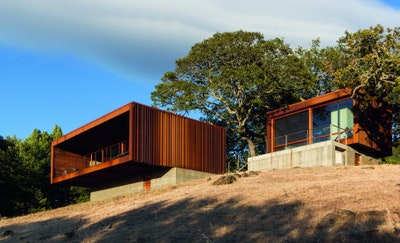
My vision for the hall is a double-storied building with multiple functionality, modular in design, prefabricated to minimize costs but clever and inspirational in design to reflect the uniqueness of the “rock”.

I’ve found this image. 

Imagine this prefabricated box on a concrete base which incorporated ranch sliders to its three sides; which could be opened to the elements to act as a transport terminus and a sound stage for entertainment. Kitchen facilities could be incorporated at the rear. A smaller separate single level prefabricated box would incorporate bathroom facilities. 

Remember I’m talking modular. Everything comes over finished and is craned to site. Foundation work only would be required being a concrete base.

The top level would jut out as depicted in this image, affording shelter. Windows would be incorporated above although as this level would be used as a library, a gallery and a reflection place, wall space would be paramount. A solar array would be incorporated. Water tanks would be behind. Generator facilities would be incorporated in the secondary structure.

Vehicular access would be restricted and the area dotted with seating, appropriate plantings and local art.

A dedicated sheltered walkway would lead to the ferry with arrivals and departures separated.

One could even imagine a café and a venue for a fishing competition.

Opinion piece: Further thoughts on Rakino Hall developments…

Vladimir Lennon is quoted as saying “There are decades where nothing happens; and there are weeks where decades happen.”

This could well be applied to the Rakino Rate Payers Association and the hall where something finally seems to be happening after decades of the same old, same old, trust me I know what I’m doing.

Perhaps the turning point was when Barbara proposed; in the absence of leadership from the Chair, a motion whereby those present at the Easter meeting voted to retain the hall or seek alternatives for the existing structure.

Certainly not a majority vote, but voted by those who could be bothered to attend the meeting which should be a wake-up call to everyone.

There is no point complaining if you can’t be bothered getting involved…and…. accepting in a democracy the majority reaches a decision and those who dissent retire with dignity. We have the opportunity to influence change now. Grasp that opportunity. Get involved. What is being talked about by the Association isn’t particularly inspirational. I’m not sure the Association has a handle on the complexities that present.

The Rakino Hall serves two functions;

  1. Transport
  2. Community

Fortunately, our civic leaders have provided the frame work for each;

In the case of transportation, the following documentation defines the way in which passenger capacity, functionality and operability is to be achieved in ferry Terminal design to meet customer expectations.

https://at.govt.nz/media/1982223/engineering-design-code-public-transport-ferry-infrastructure_compressed.pdf

Rakino seems to fit into category one and as such this is what we might expect (copied with all spelling errors left as they appear);

4.1 Terminal Type 1 Unstaffed rural, suburban or urban wharf Type 1

Terminals are relatively low patronage Terminal locations but with the potential to grow over time. This potential growth shall be factored into the space planning of the Terminal design. Type 1 Terminals shall: • Provide full mobility access • Provide canopy, enclosed gangway or other suitable shelter structure for waiting passengers • Provide accommodation for at least 50 people with at least 10 seated 03 04 TYPE 1 TYPE 2 TYPE 3 DESCRIPTION REQUIREMENTS 7 Ferry terminal design • Provide boarding platforms a minimum of 2 metres wide and 3 meters deep at standard freeboard heights of (900mm 1400mm, 1800mm) to provide near level boarding to the current ferry fleet and standard vessels specified under PTOM • Provide adequate fendering and mooring systems to allow design size vessels to safely berth in all weather conditions • Provide marine-grade non-slip surfacing resistant to scuffing by vessel gangways • Provide a safe passanger environment, fenced and gated to the fullest extent posisble to prevent accidential or unauthorised entry to water • Provide liferings and emergency ladders • Provide LED lighting to provide a safe level of brightness at all times • Provide full CCTV coverage for operational and passanger safety puposes • Provide a Public Adress system for customer service and safety announcements • Provide Emergency Help Points connected to the Auckland Transport Operations Centre (ATOC) • Provide Passanger Information Display screens (PIDS) showing real time service information • Provide AT WiFi connectivity • Provide for advertising screens to beinstalled by AT’s advertising partners • Provide AT HOP card validators (where AT HOP is utilised on services using the facility) • Provide Terminal name sign easily visible from land and water, Terminal location map and wayfinding signage to/from Terminal • Provide suitable shore supply for vessel layover incl. ducts and pipework for wash-down and multi-type/volt power connection(s) • Provide suitable storage facilities to meet ferry operator requirements • Provide litter and recycling bins • Provide timetable and customer information boards • Provide safety compliance signage • Provide cycle storage for a minimum of 10 cycles • Provide landside connections including shelter for bus services (where they are provided) • Provide car drop off point • Provide a means of closing the Terminal to public access after the last ferry service of the day.

In the case of community structures our civic leaders have provided this inspirational framework;

Community Facilities Network Plan (aucklandcouncil.govt.nz)

We are told;

Community facilities are an important part of realising the vision for Auckland to become the world’s most liveable city. They contribute to building strong, healthy and vibrant communities by providing spaces where Aucklanders can connect, socialise, learn and participate in a wide range of social, cultural, art and recreational activities. These activities foster improved lifestyles and a sense of belonging and pride among residents. The Community Facilities Network Plan (the network plan) provides a road map for how Auckland Council will invest in community facilities over the next 20 years

Toilets at the Hall

The Chair disclosed that AT was to upgrade the hall toilets; something I had not been aware of.

He suggested that exercise should be deferred pending a decision on the hall.

That makes perfect sense and suggests that AT recognizes (in part) its responsibility for Rakino’s transportation function.

A logical conclusion

Surely Rakino should simply give a fulsome thank you to our civic leaders…. we like what you’re saying and are happy to accept what you are offering.

Surely the cost should be borne by both Council and AT despite the confused distinction.

Surely any structure should be fit for purpose and inspirational but cost effective.

Surely any structure should become iconic within the Gulf, just as a simple phone box has become.

Surely everyone on Rakino should be coming up with ideas on what this new structure should look like and what function it should provide?

The Future of the Hall

The fate and future of the hall has been in almost endless discussion over recent years, but matters look like coming to a head.

The RRA committee look close to making some decisions, and they are asking for feedback with a very tight timeline. I thought I’d help out by canvassing the community about what they want from public facilities, and encourage a bit of discussion.

We are told that saving the existing hall, library, and gallery / art space is not a feasible option, so now is a critical point to have your say.

In the past few years, here’s what the facilities have been used for:

*Wedding Venue

*Parties & Celebrations

*Library

*Art Exhibitions

*Studio space for artists

*Venue for visiting musicians

*Hang out area for the kids and other table tennis fanatics

*Community meetings

*Theatrical plays

*Shelter from the storm whilst waiting for the ferry

*Storage for crappy old furniture

It has been suggested that, due to budget constrictions, a new building could not have the same footprint, and that a dedicated library and art space would not be possible.

There are an increasing number of people visiting the island, so any talk of a smaller venue is foolish. We need to plan for the future, not ten years ago.

The council seems to be prepared to cough up around $300,000.

It must be noted that a show of hands at the RRA meeting showed strong support for the construction of a new building, because it was presented as a fait accompli.

Currently, the hall has a usable space of around 50 square meters, which is marginal as far as a functioning venue is concerned. The current proposal by the RRA committee involves demolishing the existing hall and replacing it with a turning circle for SUVs. The new building would replace the existing loos which is an additional zero meters above sea level compared to its current location.

Here’s an online survey for you to have your say. Log in and check the boxes for what you’d like to see from new community facilities, also please comment on this. I must stress this survey is not on behalf of the RRA, it’s informal but hopefully useful. The results will be passed onto the RRA committee. You have 3 weeks, so get amongst it! You’ll need to log in to vote.

I would encourage you to have a read through this first.. https://www.rakino.org.nz/2021/02/15/rakino-hall-future-options/

What do you want from a community facility on Rakino?
22 votes · 183 answers