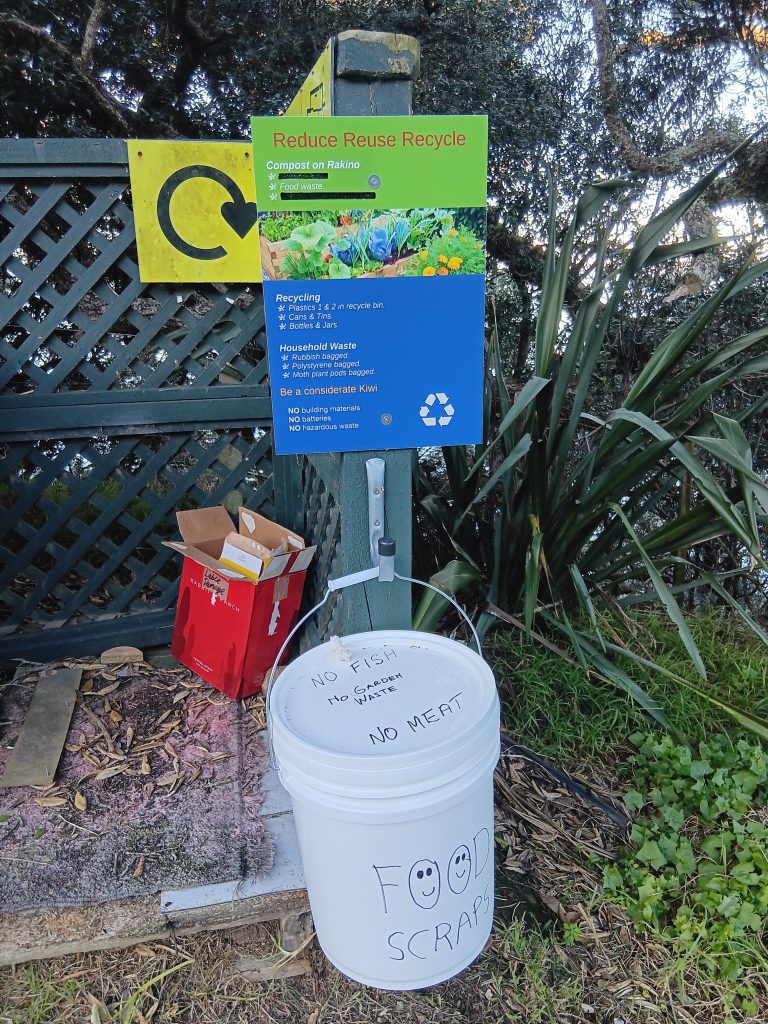
The community composting initiative got off to a great start the Matariki Weekend.
“Thank you to the Rakino Island community for using the new compost system over the long weekend. Your support means a lot.
This new system is going help us reduce the amount of waste going off island and will in time help our efforts to become more sustainable in doing our bit for the Auckland Council Waste Minimisation Initiative.
Our intended goal is to create compost for a community vegetable garden for the island so everyone can benefit from this in the near future.” says Lyndsey Williamson.
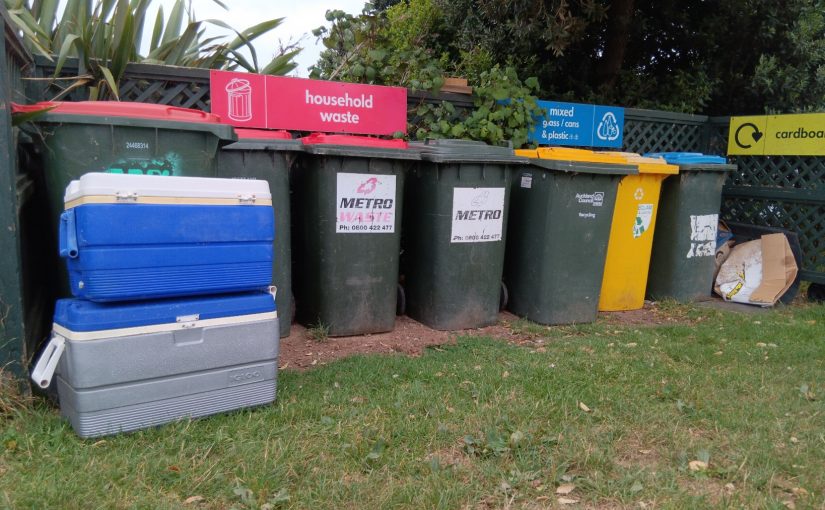
There are pails at each of the bin stations around the island.
We don’t mind where the vege scraps go, providing they don’t go into the household waste or the recycling! If you need to take some for your chooks or your own compost, that’s absolutely fine. If you want a small bench-top canteen with a handle to contain your scraps until you deliver them to the nearest compost pail, just contact Lyndsey. We have about twenty of them available, thanks to Auckland Council.
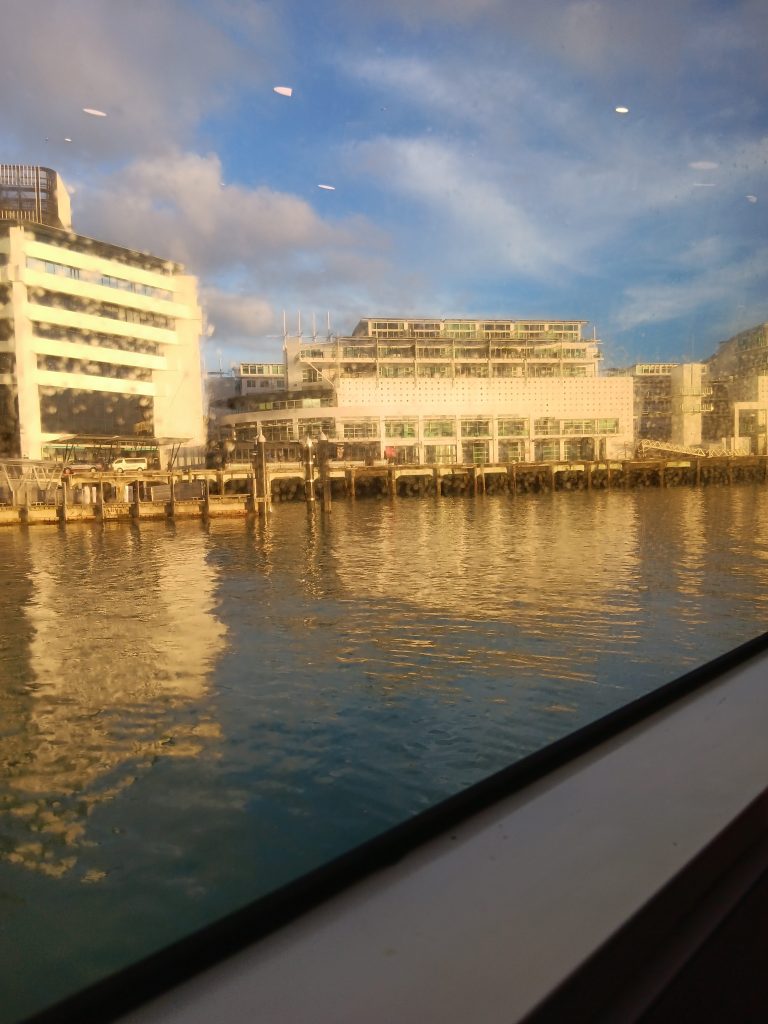
The Auckland Waterfront looking positively Venetian in the early morning.
The first day of the HGIN hui got off to a leisurely start, Auckland luxuriating in the warmth of late May sun, and a splendid day for a ferry ride to Waiheke Island to meet up with other gulf island representatives for our third Hui at Waiheke Resources Trust. It was a smaller group this meet-up but great to catch up again with Audrey from Kawau, Kristin from WRT, and finally meet Zoe in real life.
Our first activity was in the company of the wonderful Huhana Davis. Her workshop ‘Sacred Spaces in Public Places’ took us on a mini tour of Waiheke, from the beachfront at Matiatia to the silver sand of Onetangi and special places in between. I found it extremely thought-provoking, and it reinforced how strongly I feel about preservation of ‘culture’ on our islands, and the necessity to figuratively maintain a pou in the sand with regard to how our communities respect each other, and our environment. Visiting the three carved pou behind the Waiheke Library also inspired the thought that we could literally create a pou.
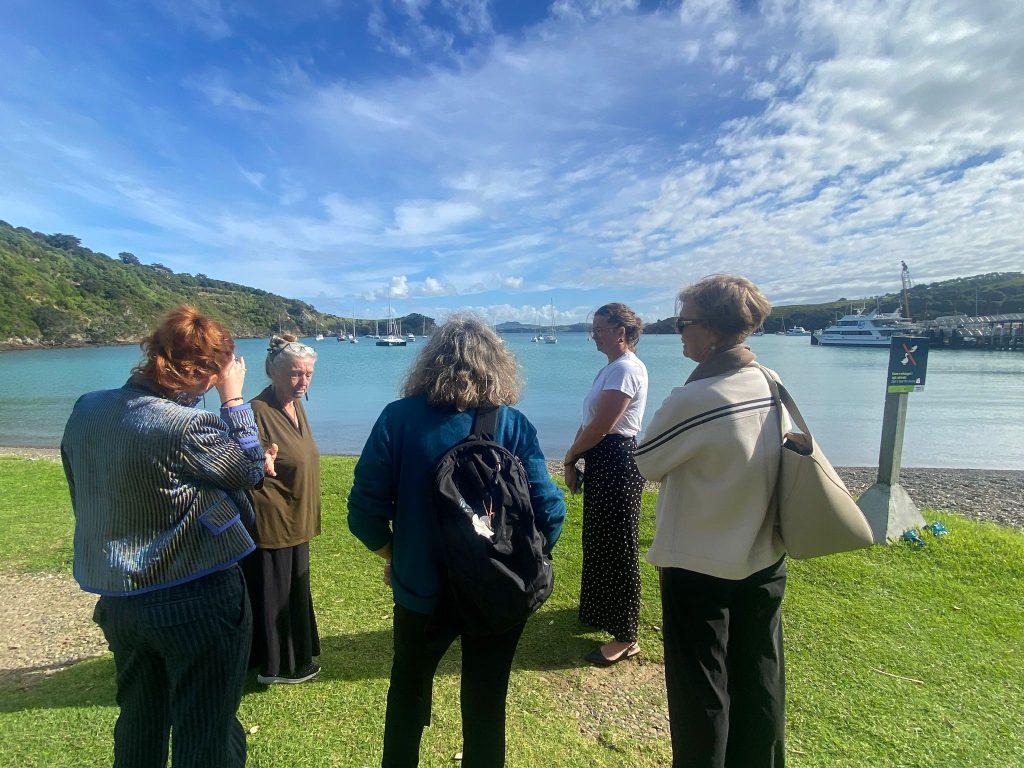
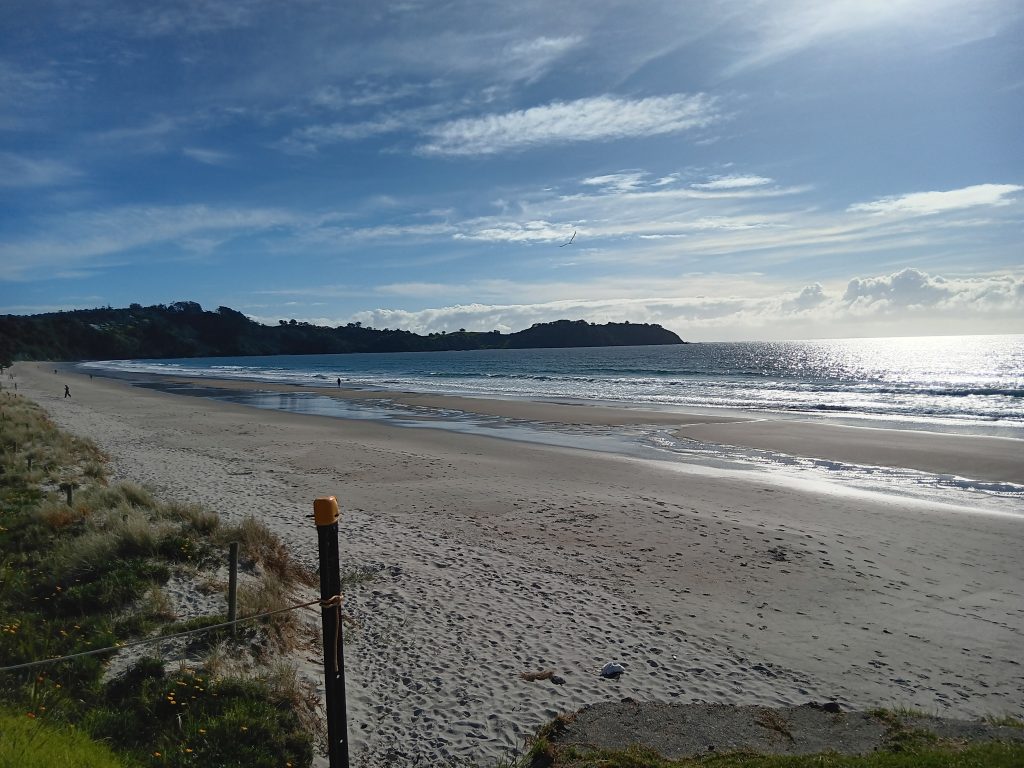
Huhana sharing her knowledge of her tīpuna with us at Matiatia.Onetangi Beach. To my shame, this was my first visit ever to a spectacular beach.
The second visit of the day was out to the Island Waste Collective to catch up with Keith Enoka. Keith’s team are responsible for reducing the waste which is transported off Waiheke. They reduce, repurpose, and recycle in an enviable fashion. Keith is ever-inventive, and the premises have grown impressively since my first visit in 2024. There are lessons to be learned with regard to waste reduction on Rakino, and the intention is to enact those lessons this year, with a community composting trial set to get underway. We also ran into Denisa, for a timely chat about moth plant eradication.
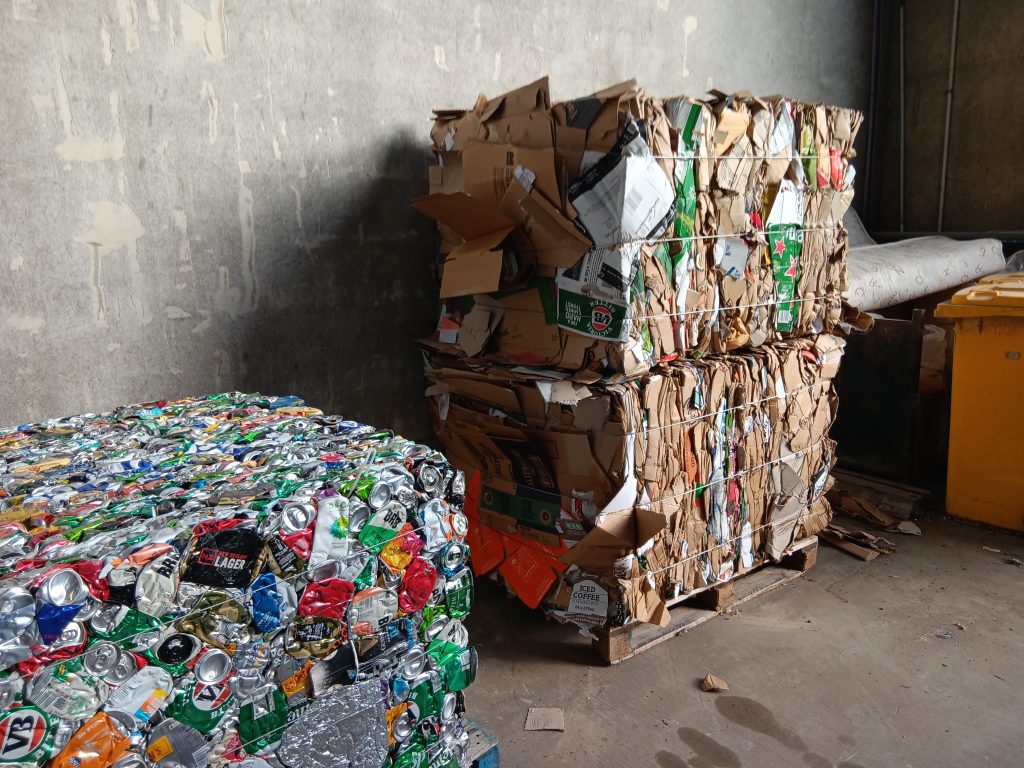
Crushed cubes of aluminium cans and cardboard at the Island Waste Collective.
This was followed up by a debrief back at the Waiheke Resources Trust before we headed out for dinner. I had to get back to Auckland in order to organise myself for the next day, a trip to Rakino! The ferry was running a tad late, but I entertained myself listening to the kororā coming ashore at Matiatia. I could see their eyes gleaming in the dark as they swam ashore before heading up the beach into the rocks, braying like mad donkeys.
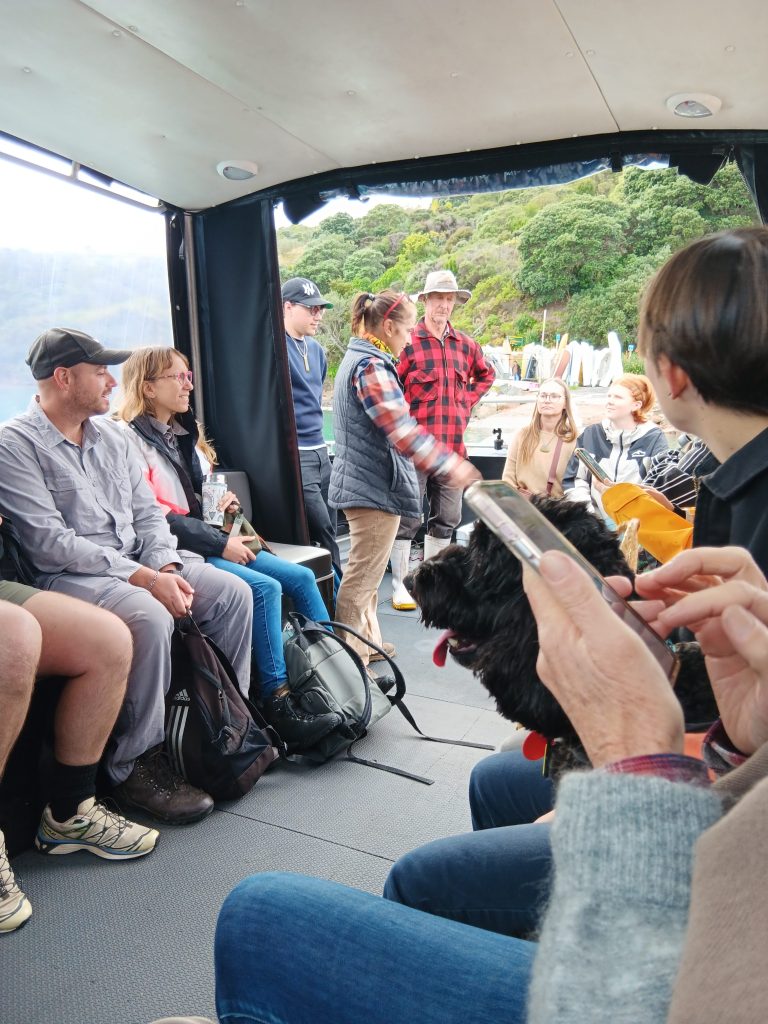
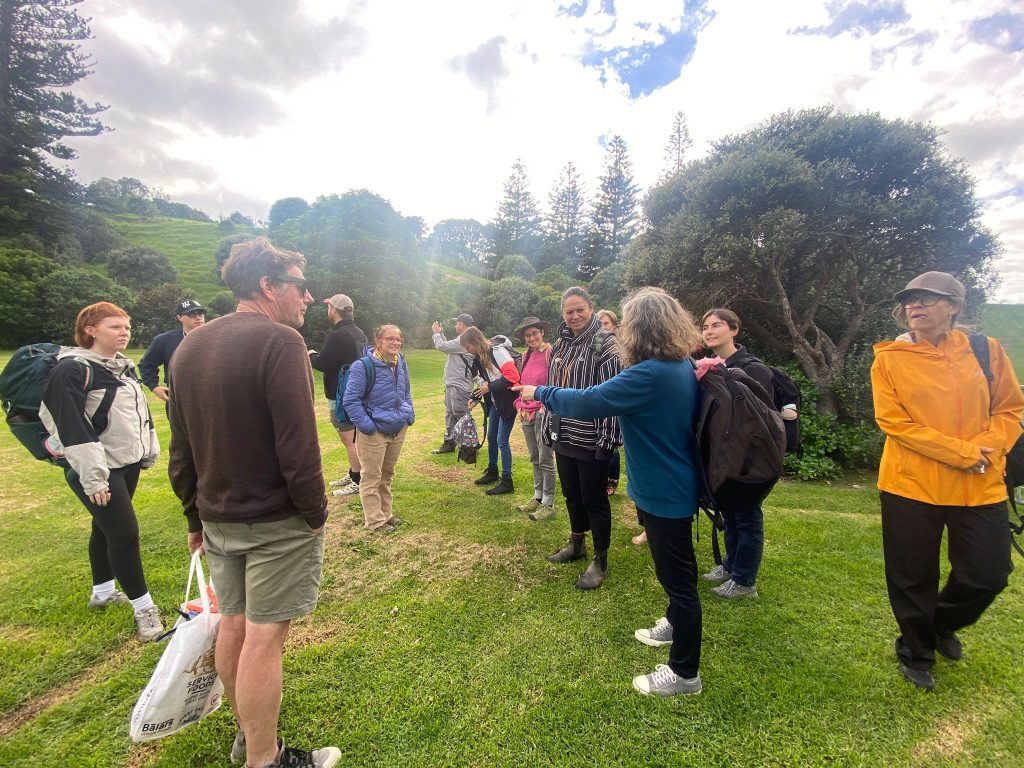
Day two began very early, lugging my pack in the dark up to the bus stop to head into town for an early ferry trip, in order to be at Matiatia on time for the water taxi ride to Rakino Island. This is the first time the Hui has taken a trip off Waiheke to visit another island, and Rakino was chosen for the inaugural visit. We had a full boat of 15, so the pressure was on… Most of the team had never visited our island, and the group was made up of people from a number of nationalities, all involved in environmental restoration, and waste reduction, as well as Kylee Matthews, chair of Waiheke Local Board, and Nicola Strawbridge, waste reduction advisor from Auckland Council.
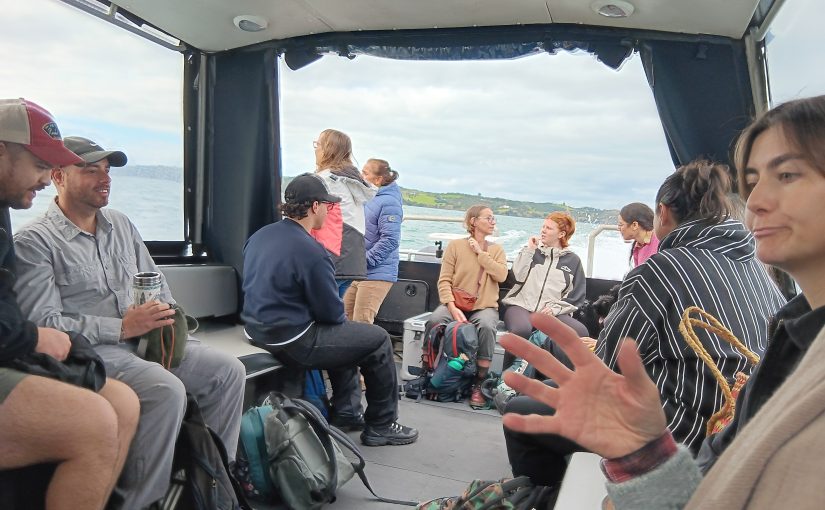
On the sea shuttle, about to head to Rakino!Upon arrival, I hold forth as everyone looks on, bemused.
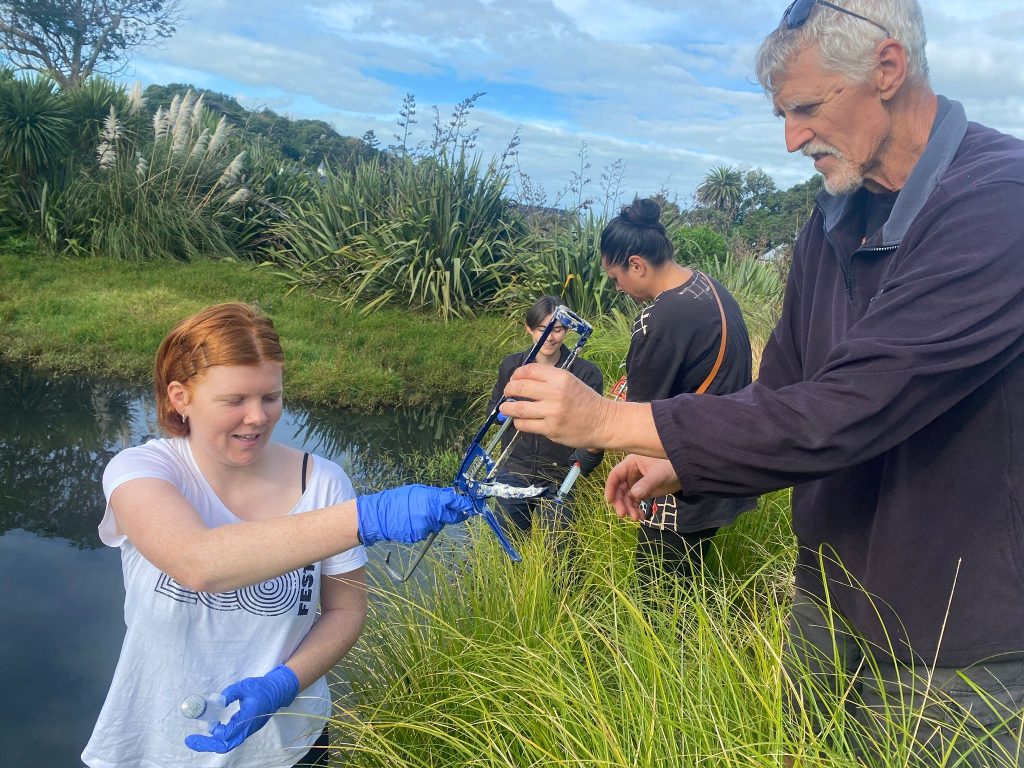
We were met at the wharf by Bert and Simon, armed with 6 scrounged caulking guns, ready for the first activity of the day, eDNA water sampling at Home Bay. Marta presided over this. It involved taking samples from two stream sites and forcing a litre of water through filters in order to collect DNA information on all the critters that reside in the stream. The caulking guns are a necessity as it gets progressively harder to force the water through the 5 micron filters as the ‘information’ builds up and collects. Water clarity is imperative as too much murkiness clogs the delicate filters. This is pretty exciting, and we can’t wait to find out what lives in this stream. The process is not inexpensive, and the data will be valuable. Many thanks to Laura for giving Bert last minute permission to conduct the testing at Home Bay.
Zoe and Bert eDNA water sampling.
While everyone else was getting their hands dirty, I was chatting with Nicola, Kristin, and Kylee about island issues; predominantly getting food out of household waste and cardboard out of the recycling with a view to supporting Lyndsey’s composting initiative, but also dealing with the interminable moth plant problem which gets worse every year. Some good ideas were tossed around, and some commitments were made.
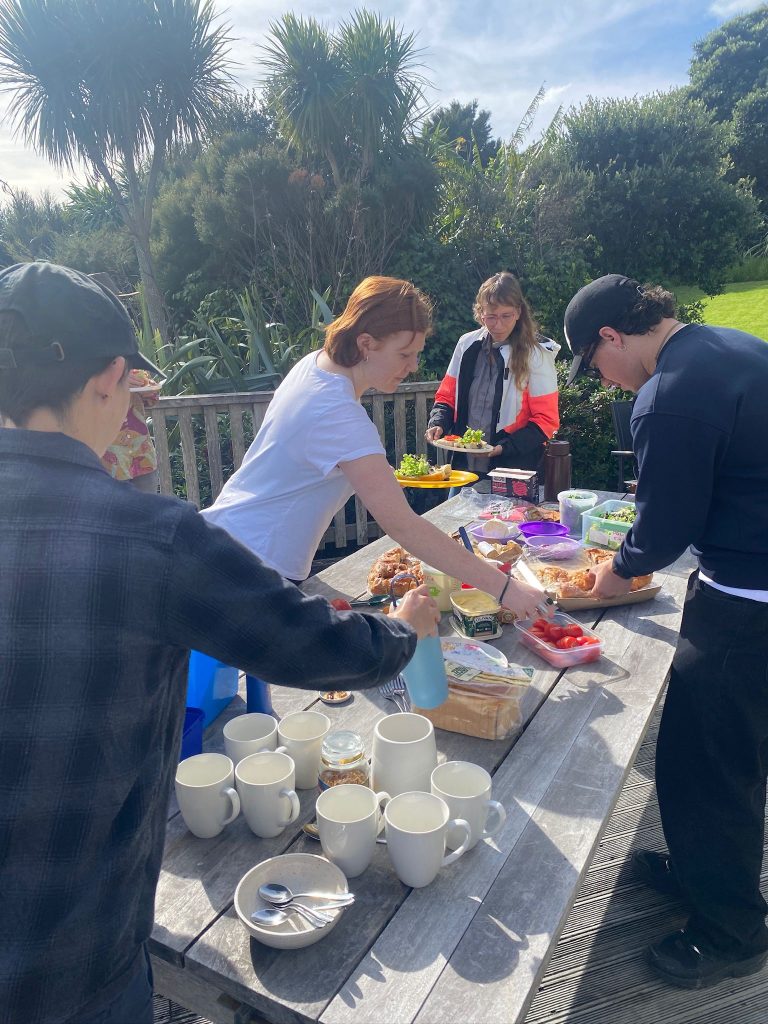
We headed up to Bert’s for a slap up picnic lunch, organised by the fabulous Kathy from Kai Conscious at the Waiheke Sustainability Center. Kai Conscious divert tonnes of food from going to landfill every year and redistribute it, or convert it into delicious shared Friday lunches. Bert’s impressive planting endeavour was much admired.
A shared feast!
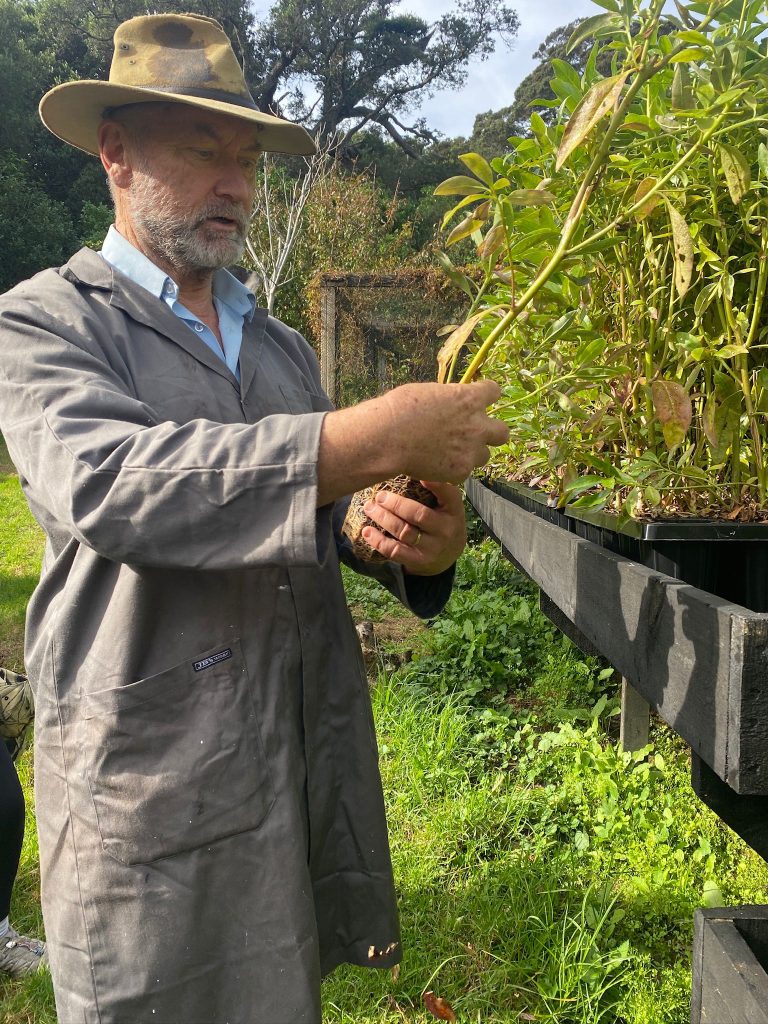
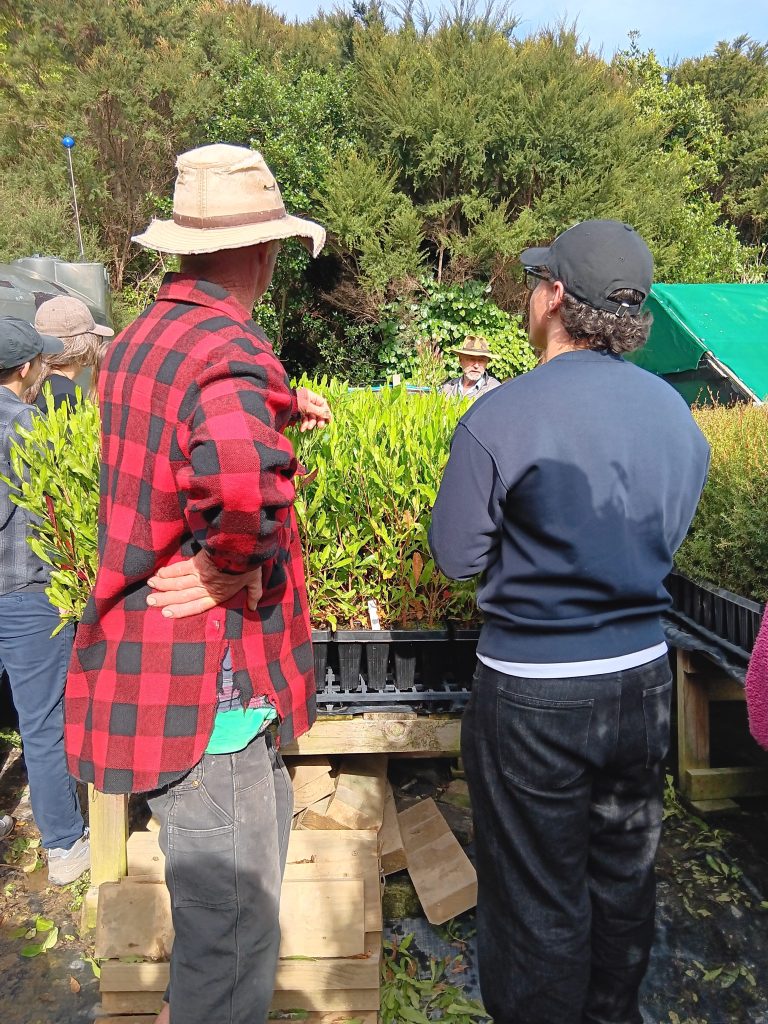
Following lunch, we marched up the hill in order to meet up with John down at the nursery. I took an inadvertent shortcut on my backside while more circumspect visitors chose a dignified entrance. John took us through the nursery, talking us through his process for ramped up tree production in order to meet the needs of larger block owners who want to do a regeneration planting on their land.
John demonstrating a fine root ball.
In recent times John has refined his growing process in order to get maximum use out off the spacial limitations of the nursery. The nursery has all its water needs met thanks to a local board grant for water tanks, and volunteers Bert and Kevin assist with the watering, which is a time-consuming job. The trees are all looking healthy, and some will be heading out for community planting this King’s Birthday Weekend.
The advantage of buying trees grown on the island is that the seeds are eco-sourced as much as possible from the geographical area of the gulf islands, but most importantly they are guaranteed pest-free. The risk of plague skinks and argentine ants is always top of mind when bringing vegetation to Rakino, and all plants must be well soaked in advance of transportation.
Rob, Ariki and much akeake.
Judi turned up with impeccable timing to offer a lift to any folk who really couldn’t face another uphill trek, and we all headed back down to the wharf to farewell our visitors. The sea looked a bit choppy, so I hope the trip back to Waiheke wasn’t too lumpy. I hope everyone enjoyed the day visit, and it’s clear there is tangible value in forging stronger connections between our islands. It was also excellent to have representatives from council visit Rakino. Many thanks to Zoe and WRT for organising the Hui and to Waiheke Local Board for supporting it. I’m already looking forward to next years meet-up.
Following on from the inspiration of the Hauraki Gulf Islands Network Hui, Lyndsey and I got permission to conduct a waste audit at the end of the recent long weekend. The purpose of the audit was to establish how Rakino-ites are utilising our rubbish collection system, whether we are recycling correctly, and what we are consigning to household waste, in order to ascertain the viability of a community composting system, with an associated community garden.
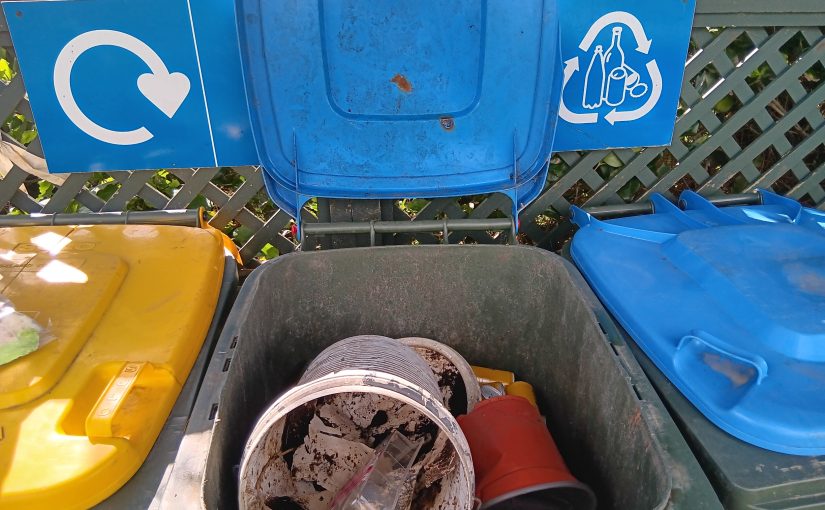
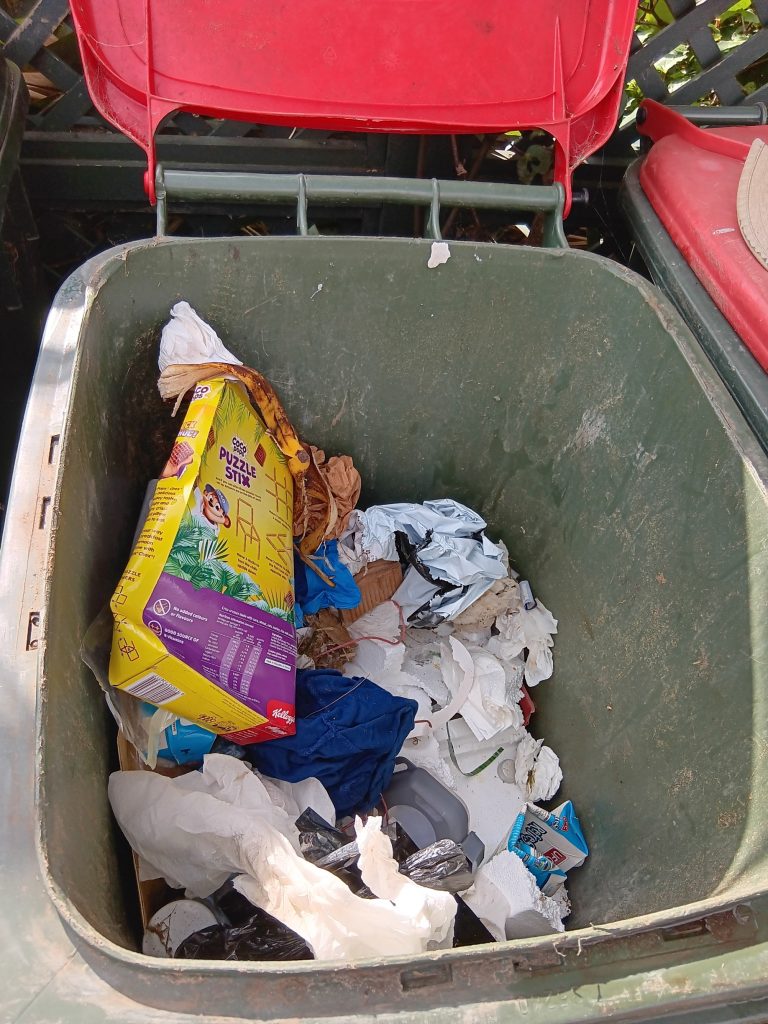
An unimpressive collection of recyclables and food scraps in the household waste bins.
We were unprepared for just how bad the rubbish disposal practises of Rakino-ites are. If we put the un-recyclables into the recycling bins in Auckland as we do on Rakino, our rubbish wouldn’t be collected. It’s only because Tom and Pat fossick through our filth in order to correctly assign it after they’ve collected it that we avoid sanction.
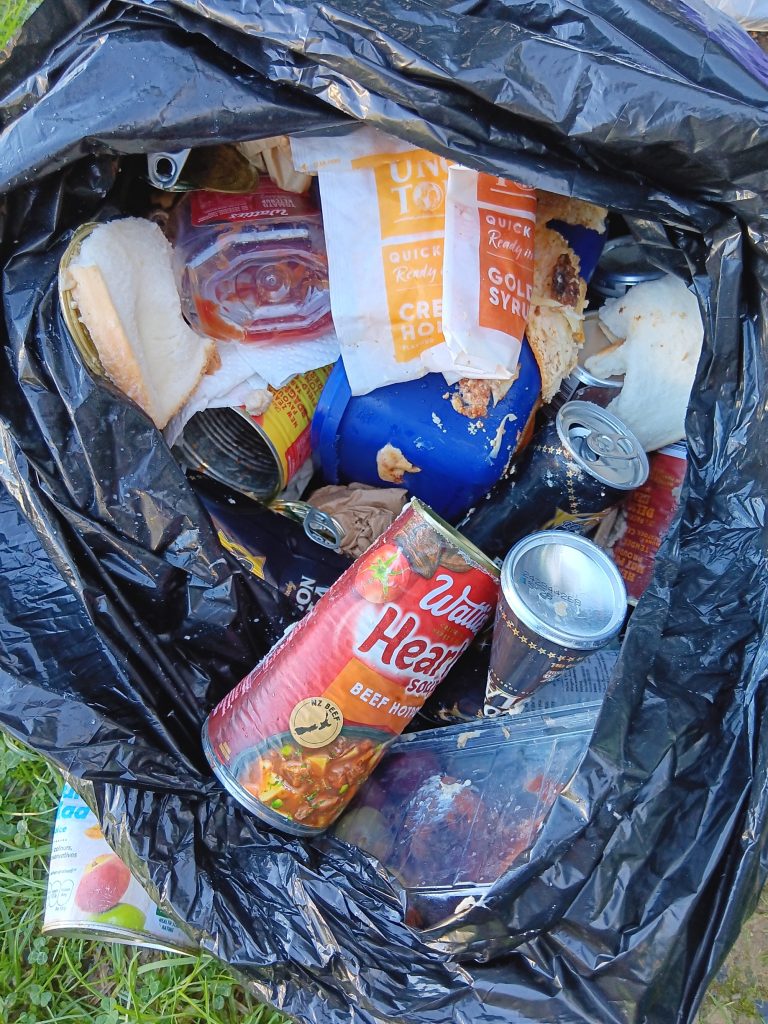
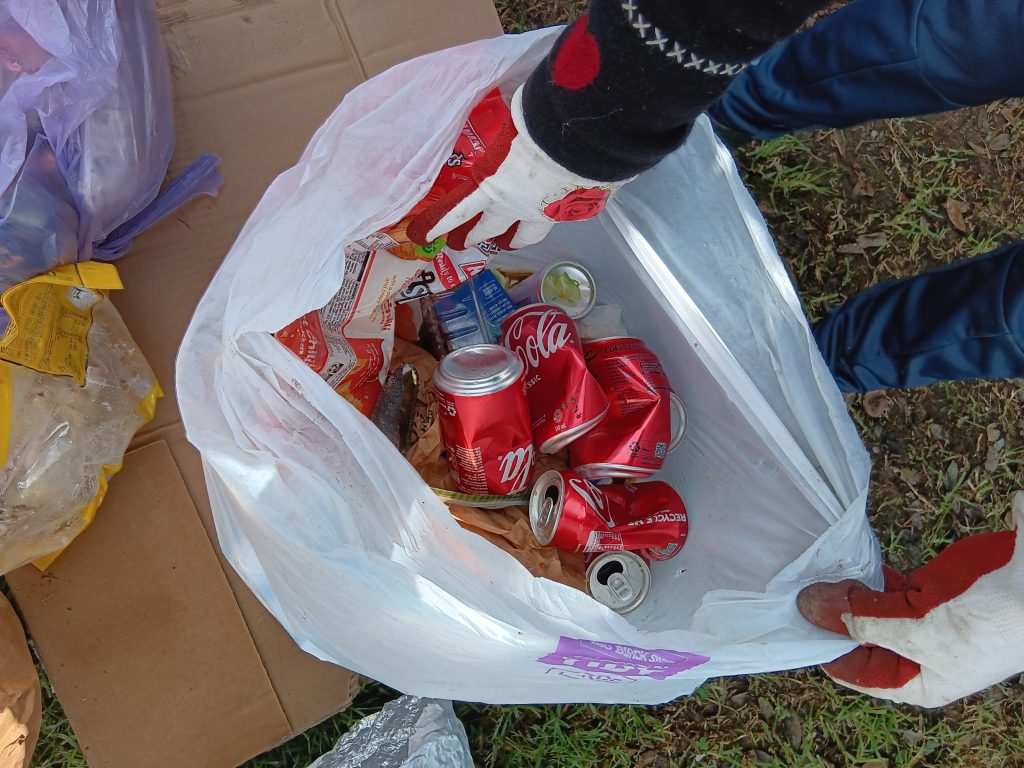
Recyclable aluminium cans incorrectly placed in the household waste bin.
Many people don’t even put their rubbish into bags to contain it. We found a lot of polystyrene which had just been shoved into the household waste bins. If you can’t take your polystyrene back to Auckland, please break it down and put it into rubbish bags with ties. This is because when the bins are emptied, the propensity for polystyrene beads and pieces to blow away is high. The same applies to moth plant pods; we hugely appreciate your efforts to remove moth plant, especially as it’s a scourge on Rakino with must be removed by landowners, according to council edict, but please put it in bags, and only the pods; not the vines or leaves.
Garbage just tossed into the bins sans bags; tissues, assorted crap, and un-bagged polystyrene.
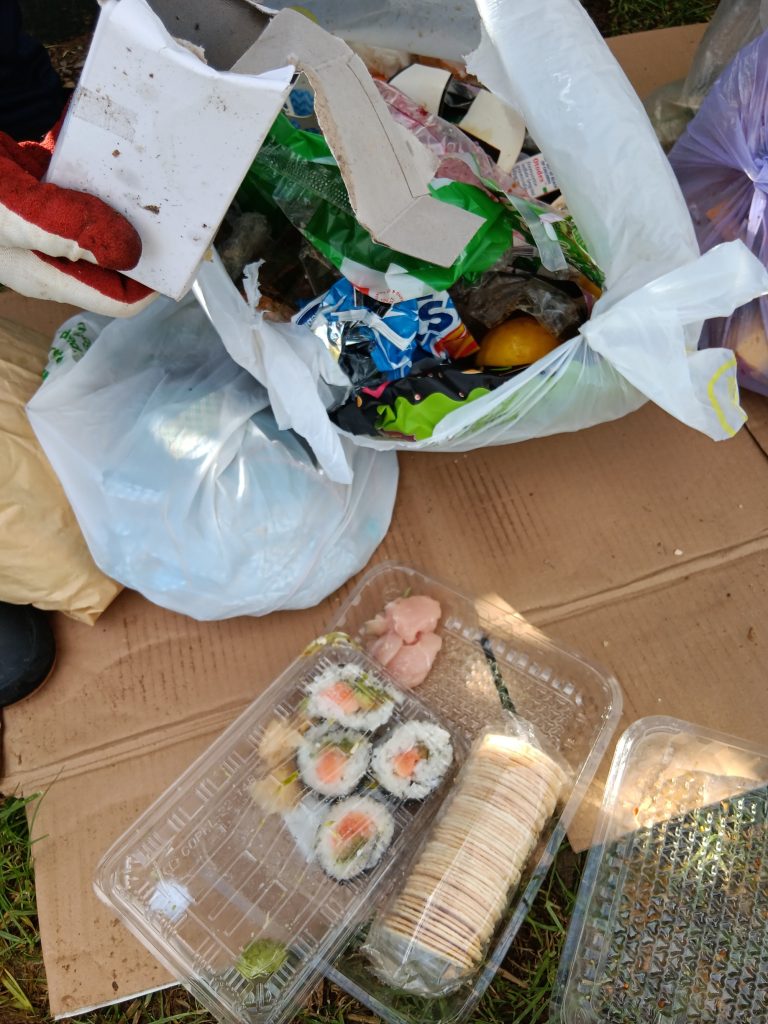
The worst aspect was the volume of food waste. Food waste was mixed in with recyclables, and all tossed together into household waste bins. Come on, people; we have no rats on Rakino so you could simply bury it, though much of the food we found was still edible, which was quite confronting.
We need to set up a system for food rescue, followed by community composting.
Lyndsey and I are proposing setting up a system to improve the way we deal with waste on Rakino. At this point we can’t do much worse than we are currently; it’s disrespectful to Tom and Pat, and it’s disrespectful to our environment. Living ‘off-grid’ is much more than just collecting rainwater and making solar power. It’s also about treading lightly on the land, reducing, re-using, and recycling.
We intend to see all food waste, brown cardboard, and green waste diverted to community composting, apart from the modest amount that is currently diverted to Pat’s chooks, of course.
Initially we want to supply a few households with small plastic bins with handles, essentially the green compost collection bins we have in Auckland. Tom has generously offered to set aside some waste collection bins for food waste, which will be delivered to our compost site. We will also be removing cardboard (brown carbon waste) from the rubbish collection in order to compost this along with food waste, and we will be encouraging green waste to be donated to the compost scheme, rather than left lying around, or tossed down banks or onto neighbours’ properties. There is funding available, and we intend to go for it. This is Lyndsey’s baby, and it’s going to be a great success. Just watch this space.
Reading the minutes of the Labour Weekend RRA meeting I saw that someone had brought up ‘rubbish’ as an issue. I’m still uncertain as to what the issue was, as no-one I spoke to could remember the specific details of the topic as it was discussed, so I guessed it was probably something to do with putting recycling correctly in bins and composting food scraps instead of throwing them out with household waste.
I put my hand up to look at the way Rakino-ites put our waste into the communal bins because I’ve had some unpleasant olfactory surprises over the years when I’ve gone to dump my own recycling/household waste after my island visits. I’ve also been perplexed at the sheer volumes of waste that Tom has to deal with after busy weekends, the perennial issue of dead and dying vehicles, and the annual consternation around inorganic collections.
After speaking to Kayleigh Appleton at Waiheke Resources Trust I had an enthusiastic online meeting with representatives from the Island Waste Collective on Waiheke, and the WRT. The discussion was wide-ranging, but the most useful things I took from it was the possibility of availing ourselves of a can crusher from Waiheke, and diverting cardboard from the waste stream going off -island into a community composting initiative. Waiheke Resources Trust would happily provide a composting workshop for interested Rakino-ites.
Keith Enoka, General Manager of Island Waste Collective put me in touch with Bret Dragt from Auckland Council, who sent through the Gulf Islands Waste Plan written in 2018 with input from the Rakino Community, and some useful tips for household waste reduction.
Regretfully we have failed to achieve the waste reduction goals as set out by ourselves.
Tom has done an excellent job on the rubbish contract, tidying up the previous shambles at Home Bay, keeping the bins clean and tidy, and generally cracking down on illegal dumping as far as it is possible, but bach owners, myself included, could be doing a great deal more.
As you can see, the ambition was to achieve the aforementioned composting scheme and use cardboard brown waste on-island, but this hasn’t happened. The bokashi bins have also not been utilised to their full potential. It’s a lost composting opportunity.
Bret Dragt also provided this helpful guideline for waste reduction :
As you can see, the same issues still exist, six years on. The C & D waste referred to in the document is Construction and Demolition waste, the removal of which is the responsibility of builders and householders at their own cost, NOT the council and it’s contractors.
The lowest hanging fruit we can deal with immediately is removing all food waste and cardboard from the waste stream.
I propose we avail ourselves of a community composting workshop via the Waiheke Resources Trust, for any bach owners or residents who want to become composting ninjas. Given that the proportion of green waste to brown waste (paper/cardboard) should be about 50/50 in a successful compost I believe we could eliminate cardboard from the piles of waste which travel off-island. I’m happy to facilitate the organisation of a composting workshop.