Kevin Wragge has kindly alerted me to this excerpt from the Waiheke Local Board minutes from a couple of years ago. If you have any interest in the future of our Hall/art space/library, it’s a worthwhile read. Feedback is encouraged and welcomed, as this becomes an increasingly pressing issue.
| Waiheke Local Board 13 December 2018 |  |
Rakino Hall future options
File No.: CP2018/22342
Te take mō te pūrongo / Purpose of the report
1. To recommend to the Waiheke Local Board a preferred option to address Rakino Hall’s future.
Whakarāpopototanga matua / Executive summary
2. The question of how best to maintain the ageing Rakino Hall, its future and management model has been considered on and off for over a decade without resolution.
3. As the hall is located right on the edge of the Rakino wharf reclamation, it is subject to direct wave action from time to time and a recent engineering assessment costs options to address this as ranging from $290,000 to over $1m.
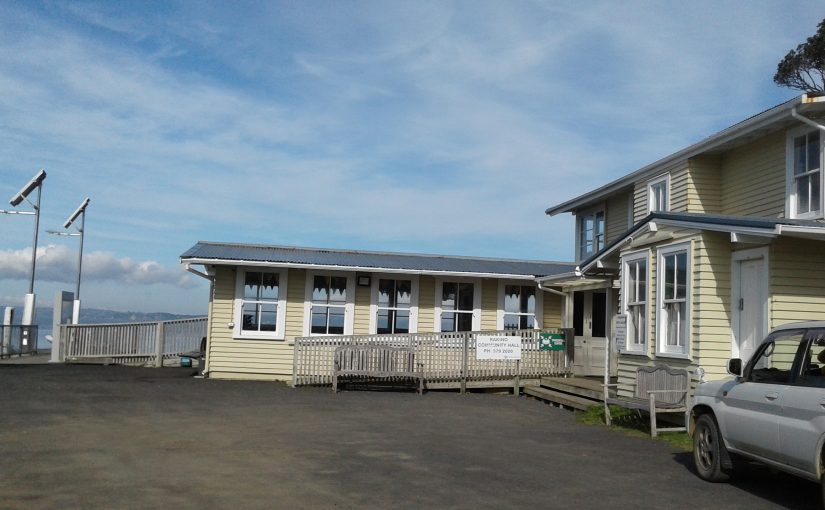
4. Although Rakino Hall provides an important community and visitor function, it serves a very small community and the expenditure of this quantum of public funds needs careful consideration.
5. This report notes that council’s renewals budget can be used to fund the $290,000 “lift and shift” option although this may have an impact on other priority renewals work. It recommends this option be included in the 2019/20 renewals work programme for consideration and subject to it being consulted on and supported.
6. The report also discusses options for the future management of the hall and recommends that the lift and shift option be subject to agreement being reached on future management. It recommends the preferred option as being transfer of the hall to the Rakino Ratepayers Association, or secondly a community lease if the association agrees.
| Te tūtohunga / Recommendation That the Waiheke Local Board: a) agree to allocate $290,000 in renewals funding to lift and shift Rakino Hall as per Option 1 in the Tonkin and Taylor Rakino Hall coastal hazard issues and options assessment final report dated November 2018, subject to the following: i) the proposal being considered alongside other renewals priorities in the 2019/20 work programme ii) the proposal being consulted on through the 2019/20 Waiheke Local Board Agreement process and sufficient support being received for this proposal iii) on project completion Rakino Hall is either transferred to the Rakino Ratepayers Association at no cost or managed in a manner agreed between the local board and the association iv) associated land lease and reserve classification processes which include iwi consultation, being completed. |
Horopaki / Context
Hall ownership and land status
7. The Rakino Hall is an Auckland Council community facility managed by council’s Community Facilities department. It was moved to Rakino Island in the early 1960s from Motuihe Island where it had been a World War Two Navy barracks.
8. The hall partly sits on a reclamation at the southern end of the island as shown in the below photo. The reclamation’s southern edge is both a seawall and foundation for the hall. The reclamation and associated structures also form the island’s public wharf which is managed and maintained by Auckland Transport.

9. Rakino Hall consists of a main community room (single storey building in the photo), a kitchen and library which occupy the bottom part of the building to the left, and an upstairs art gallery and separate toilets to the rear.
10. The hall straddles two land parcels. The hall itself sits on the eastern parcel which is crown owned, classified as a local purpose (community buildings) reserve, and vested in the Auckland Council. The two storey part of the building sits on the western parcel which is held in fee simple by the Auckland Council as an unclassified esplanade reserve.
11. Under the Reserves Act 1977, buildings are not permitted to occupy esplanade reserves so the area occupied by these facilities has now been surveyed to enable the whole footprint to be classified as local purpose (community buildings) reserve.
Hall use
12. The island has a permanent population of around twenty and up to 250-300 at peak periods during the summer holidays.
13. As Rakino Hall isn’t on council’s on line booking system, no formal council held record of use is available. The Rakino Ratepayers Association and the Rakino Hall Committee chair have provided information showing that annually, over 20,000 people use the hall for one purpose or another or arrive by boat and interact with the hall’s facilities. This usage report is included at Attachment A.
14. Other advice on the hall’s purpose provided previously by the association can be summarised as follows:
i. the hall is the only public facility on the island
ii. it is the natural hub for all movements to and from the island and provides shelter for those waiting for boats or ferry services
iii. it enjoys regular use by the community and in the last couple of years there have been many large events enjoyed by large numbers of locals and visitors based in and around the Hall
iv. as well a hall, it functions as the island’s library and arts centre, an evacuation and civil defence assembly centre and first aid post. It also has an emergency phone, post boxes and storage for fire and pest control equipment
Hall management and maintenance
15. Auckland Council and/or the local community have managed and maintained the hall in a variety of ways over the years depending on council systems and processes at the time, practicalities and the Rakino community’s interest and ability to do more or less.
16. For a period of time prior to 2015 council sub-contracted a resident builder to do necessary work. For a couple of years after that the Rakino Ratepayers Association was officially contracted as hall caretaker and managed hall use, bookings and general care. In the past the association has undertaken various internal repair works including the replacement of damaged flooring in the main hall area and refurbishment of the art gallery at its cost.
17. The hall is currently maintained by council’s Community Facilities department in a reactive manner in response to requests and issues. The association has suggested that the building has deteriorated due to the lack of a regular maintenance programme.
18. Council sends contractors over as needed. The association notes that this arrangement is costly as often contractors need to come and assess what needs to be done, and come back again to do the work. Under the above past arrangement with a local builder, the initial assessment was done locally.
19. In January 2018 a major storm over Christmas which coincided with a king tide resulted in damage to the parts of the hall. Locals undertook a range of repairs over the holiday period including removing the deck and replacing floor joists/ties, piles and weatherboards at their own cost.
Hall coastal protection
20. As Rakino Hall is located right on the southern edge of the reclamation as shown in the above photo, it is constantly subject to coastal processes. At times these can be quite severe as shown in the below photo. There have been a variety of reports written and options identified to address these issues over the years.

21. A 2012 report prepared for Auckland Transport proposed a replacement seawall in front of the existing concrete wall which was described as nearing the end of its life. It noted that only a remnant of a historic grouted rock wall intended to dissipate wave action remained (see top hall photo). This proposal never proceeded.
22. In October 2014 the Waiheke Local Board received a report recommending that the hall be re-sited to prevent the threat of damage from severe storms and high tides. The board allocated $66,000 from its 2014/15 renewal budget for this purpose. Subsequent investigation identified that actual costs would be significantly greater and the proposal never proceeded.
23. More recently Auckland Transport investigated what might be needed to protect the southern side of the reclamation and had a preliminary design for a new seawall costed at around $88,000. This wasn’t taken further as a resource consent was needed which was seen as outside Auckland Transport’s responsibilities.
24. Council staff supporting the Waiheke Local Board’s interest in finding a way forward have recently looked into resource consent requirements for coastal protection works within the coastal marine area. This showed that such works would be expensive, potentially not get approval anyway and that regardless, they risked doing no more than just lessening the impact of storm events.
25. In August 2017, council staff and Waiheke Local Board members met on site with a sub-committee of the Rakino Ratepayers Association formed specifically to discuss a way forward for the hall. The council team included two asset assessors with a specific role to investigate the hall and associated seawall condition and report back.
26. Notes taken by the sub-committee record that council staff advised that the condition assessment could be carried out within a month and this would form the basis of a service solution which could take a further 4-5 weeks. The sub-committee asked that these results be provided in time for the Rakino Ratepayers Association’s Labour Weekend 2018 50 year celebrations.
27. Two separate asset assessments were prepared for the hall and associated coastal assets. The hall assessment noted that while there were some repairs required, overall the building was in reasonable condition and should be fit for purpose for many years if properly maintained.
28. The hall assessment noted that the building is poorly located and suffers from sea action particularly during south-westerly storms. It recommended investigating a number of options including additional sea wall protection, relocation and raising the building on site, demolishing the existing building and constructing a new purpose built facility off-site.
29. The coastal assets assessment included the seawall, wharf and breakwater as well as the hall deck, overhanging roof and foundations. It concluded that a buffer zone of rocks/boulders in front of the wharf and beneath the location of the deck and rebuilding the remnants of the existing breakwater would be the most effective way to dissipate the wave energy from reaching the building directly. It recommended removal of the deck which had been damaged and is in poor condition.
30. Both reports recognised that various consents and more technical investigations would be needed to advance these options. In further discussions with council’s coastal management services staff, it became clear that obtaining consents in this coastal environment would be difficult and it was agreed that a more formal and comprehensive report on options was needed. At its 26 July 2018 meeting the Waiheke Local Board allocated $20,000 for this purpose.
31. Tonkin and Taylor were engaged to prepare this report which discusses the scale and type of coastal hazards faced by the hall and possible measures to address them. A copy of the full report which is a desk top report (no-one went on site) is included at Attachment B. Its executive summary (paraphrased) states that:
· Rakino Hall is already subject to coastal inundation and erosion due to its location and these hazards are likely to increase with increasing sea level rise
· The following six options were investigated at a high level to address these issues, including construction costs, effective design life (particularly in relation to sea level rise), planning issues and constructability.
i. Relocation on existing reclamation (lift hall 1m, shift back 5m, build a 1m wall on the reclamation edge)
ii. Relocation to alternative site
iii. Vertical seawall with a crest of 4.0m (and associated reclamation)
iv. Rock armour revetment with a crest of 4.0m (and associated reclamation)
v. Raising reclamation levels
vi. Demolition and new structure at alternative location
· These options provide a solution for a certain time period and then additional actions may be required depending on the rate of climate change
· Raising the seawall (either via a vertical seawall or rock armour revetment) or moving the Community Hall back on the reclamation) would be effective for a period of 30-50 years, depending on the rate of sea level rise. Other options would be effective for significantly longer periods of time.
· Collaborative engagement with the community and additional planning investigations is recommended.
32. Each option is considered in detail in Section 4.2 of the report and summarised in section 4.2.6. (see Table 4.7 included here).
Table 4-7 Summary of options with rough order costs and main planning, consenting and constructability issues
| Option | Construction rough order costs (rounded) | Effective design life | Planning issues | Constructability |
| Option 1: Relocation on existing reclamation (Site shift) | $ 290,000 | 30 to 50 years (2050-2070) | Consent required, but generally consistent with zoning provisions. | Medium |
| Option 2: Relocation to alternative site | $ 423,000 | 100+ years | Need to confirm ability to construct on proposed location, extent of tree pruning, support of local community | Medium |
| Option 3: Vertical seawall | $ 529,000 | 30 to 50 years (2050-2070) | Potentially challenging planning direction which may not support reclamation | High (intertidal and restricted access to CMA) |
| Option 4: Rock armour revetment | $ 255,000 | 30 to 50 years (2050-2070) | Potentially challenging planning direction which may not support reclamation | High (intertidal and restricted access to CMA) |
| Option 5: Raising reclamation levels | $ 938,000 | 100 years | Impact on other amenities particularly the wharf | High (complex staging to retain wharf operations and parking) |
33. The Waiheke Local Board has considered this report and next steps at recent workshops and suggested that in view of its budget constraints, the age and life of the facility and the importance of wisely spending ratepayers funds if it was to support any option it would most likely be Option 1. The board also agreed to provide the report to the Rakino Ratepayers Association to be considered at its 2018 Labour Weekend AGM and the association has responded that its preference is for Option 1.
34. The local board also asked staff to investigate alternative scenarios such as granting the association adequate funds to develop a facility elsewhere. This is discussed further below.
Tātaritanga me ngā tohutohu / Analysis and advice
35. Despite a number of investigations over the years into how best to protect and manage the hall, there has been no follow through and these issues remain unresolved. The purpose of this report is to seek decisions that will conclude these matters.
36. While the most pressing issue is protecting the hall from coastal impacts, it is considered that agreeing how the hall should be managed and by whom should also be concluded at the same time.
37. Rakino Ratepayers Association representatives are expected to attend the board’s 13 December business meeting and speak at public forum in response to this report’s recommendations.
Addressing coastal process issues
38. Staff consider that the following options are available to the Waiheke Local Board:
· Do nothing
· Pursue any of the Tonkin and Taylor report options
· Investigate other options
39. Staff consider that the “do nothing” option, is really the status quo and is not an option if issues and history outlined above are to be resolved. Doing nothing would involve normal maintenance of the hall in its current location. Eventually coastal processes are likely to significantly damage the hall resulting in either expensive repairs or the need to demolish all or parts of the building. This could occur at any time.
40. Staff have confirmed that renewals budget is available from 2019/20 to progress Tonkin and Taylor’s Option 1 ($290,000) without compromising delivery of other renewals priorities. As this is a rough order cost estimate only based on a desktop exercise, a more detailed cost investigation would be needed. The cost does however contain a 30 per cent contingencies allowance and the Rakino Ratepayers Association has advised that it could undertake some works itself, such as site preparation and re-establishment which are costed at $40,000.
41. Option 1 appears to be the only one of Tonkin and Taylor’s options that would attract renewals funding. The Waiheke Local Board has no other budgets which are either sufficient or can meet the criteria to progress any of Tonkin and Taylor’s other options.
42. The diagram explaining Option 1 from Page 12 of the Tonkin and Taylor report is shown here. As noted earlier, this option involves lifting the hall 1m on the existing hardstand, moving it back 5m and building a 1m seawall on the hardstand edge.

43. Other options could include demolishing and not replacing the Rakino Hall. This will clearly be opposed by the Rakino Ratepayers Association. Demolition will itself come at a cost and given the wider uses of the hall such as a waiting area for travellers, and storage for emergency equipment etc, some form of shelter would need to be retained or constructed.
44. A further option suggested by the local board is to provide a grant to the association to construct a facility elsewhere owned and managed by itself. Staff advice is that this would need to be funded by the local board and it does not appear there are either funds available, or a suitable mechanism to achieve this.
45. Based on the above this report recommends that the Waiheke Local Board allocates $290,000 from its renewals budget to pursue Tonkin and Taylor Option 1. Given this cost relative to the small size of the Rakino community and other funding priorities, it is further recommended that the local board consult on this option as part of its coming 2019/20 Waiheke Local Board Agreement consultation process.
46. It also recommends that progressing Option 1 be subject to a decision on the hall’s future management being made and this is discussed further below.
Addressing future hall management
47. The question of which party or method should be used to maintain and manage Rakino Hall has never been comprehensively considered or answered. As noted above, Rakino Hall has been managed and maintained in different ways over the years. Formal responsibility for its maintenance and management sits with Auckland Council.
48. It is recommended that a preferred hall management option should be discussed and agreed with the Rakino Ratepayers Association before a final decision to support Option 1 is made. This is because the proposed hall renovation investment is considerable and it makes sense that a hall management solution covers both structural and management matters.
49. Staff consider that the following options are available to the Waiheke Local Board:
· The council continues to maintain and manage the hall
· As above but with agreed roles being undertaken by the community
· The hall is leased to the Rakino Ratepayers Association and it assumes associated responsibilities
· The hall is transferred to the Rakino Ratepayers Association at no cost and the association is granted a lease over the land.
50. While the council managing and maintaining the hall is the default position, this is not necessarily the best option for the future and hasn’t resulted in the best outcomes in the past. It costs more for the council to manage and maintain the hall remotely from the city due to distance and the absence of island based contractors.
51. Ongoing changes in council processes, systems and structures are considered to have contributed to hall management and structural matters remaining unresolved. They have also contributed to dissatisfaction being expressed by the Rakino community and locals getting on and doing things when they had to be done and the council wasn’t responsive. This has included significant maintenance and renovation works at times at no cost to the council, for example removing the deck and repairing foundations damaged in the most recent storm.
52. This is the option of the council continuing to manage and maintain the hall with certain aspects being led by the community, albeit with costs paid by council as needed. Having locally based contractual arrangements as has happened at times in the past would fit into this scenario.
53. A formal lease over the footprint of the building to the association is another option. This would enable the community to manage the hall as it saw fit within the terms of the lease and free it from the issues it has experienced with council management. Although actual costs would fall to the community, in large part this appears to be what has happened to a greater or lesser extent over time anyway.
54. Formal transfer of the hall to the community is the end of this spectrum with the community taking control of the hall’s future use and purpose, but still within the restrictions of the land’s reserve status. While the council’s resources wouldn’t be automatically available, the community could still apply for grants and assistance as many community groups which own halls do already.
55. As noted above, any management outcome needs beyond the status quo needs to be discussed and agreed with the Rakino community. These options have been discussed in detail with the chair of the Rakino Hall sub-committee, including hall transfer to the association. Concerns were expressed about both transfer and lease options. These included it being the council’s obligation to manage and maintain the hall, costs, differing views within the association and anxiety that this could create internal problems, and the benefit of council managing the administrative burden given the finite resources of the community. In the past at least there has been some appetite expressed for transfer provided structural issues were addressed at the same time.
56. This report recommends that the Waiheke Local Board seek local ownership or management of the hall for the reasons outlined above. This seems like a practical solution for a hall which has been lifted and shifted, which will be safe and secure for a further 30-50 years and which is hard for the council to manage well given its remoteness.
Ngā whakaaweawe ā-rohe me ngā tirohanga a te poari ā-rohe /
Local impacts and local board views
57. The Waiheke Local Board is the decision-maker over matters covered in this report.
Tauākī whakaaweawe Māori / Māori impact statement
58. No iwi consultation has been undertaken in the preparation of this report. Iwi will be consulted as part of the proposed 2019/20 Waiheke Local Board Agreement consultation, if the local board agrees to pursue Option 1. Resource consent and land classification processes would include iwi consultation.
Ngā ritenga ā-pūtea / Financial implications
59. If the Waiheke Local Board supports proposed Option 1, it would be funded from its renewals budget.
60. There are a number of pressures on the Waiheke Local Board’s budget for next year which might impact on the ability to advance the Rakino Hall project. These include a desire to fast track the skate park, and unresolved budget pressures on Onetangi Beach access points and the golf club access road.
61. Trade-offs, along with project timing, scope and cost reviews will be needed. Rakino Hall can be considered alongside these other priorities as part of the 2019/20 work programme agreement process.
62. If Rakino Hall is no longer formally managed or maintained by Auckland Council, this will reduce ratepayer costs. If the Rakino Ratepayers Association was the owner or manager, it would be able to apply to the Waiheke Local Board for grants to support its activities.
Ngā raru tūpono / Risks
63. The biggest risk is considered to be that no clear decisions are made on the hall’s future. Given the structural risks identified in the Tonkin and Taylor report, staff recommend that a clear direction is identified and agreed by the local board.
64. A further risk is that using $290,000 in renewals funding for Rakino Hall might compromise the ability of other high priority projects to proceed or be completed.
65. There is also a risk that discussions around what to do create relationship issues both between the parties and internally with the Rakino community.
Ngā koringa ā-muri / Next steps
66. Next steps will depend on the local board’s decisions on this matter.
67. If the board supports using renewals funding to lift and shift the hall, the renewals team will investigate and progress the steps needed for that. If this isn’t supported and there is no change to the hall management approach, the hall will need to be appropriately maintained by the council. If storm events result in further damage, decisions will need to be made on its future in response to these impacts.
68. If the board supports any change to management arrangements, those will determine next steps we agreement, leases, roles etc.
Ngā tāpirihanga / Attachments
| No. | Title | Page |
| a⇩ | Rakino Wharf Building & Hall Facility Usage Data | 29 |
| b⇩ | Tonkin and Taylor Rakino Hall Coastal Hazard Issues and Options Assessment | 31 |
Ngā kaihaina / Signatories
| Author | John Nash – Programme Manager,Waiheke & Gulf Islands |
| Authoriser | Helgard Wagener – Relshp Mgr – Great Barrier and Waiheke |
| Waiheke Local Board 13 December 2018 |  |

The attachment below is the Tonkin and Taylor report prepared for council.